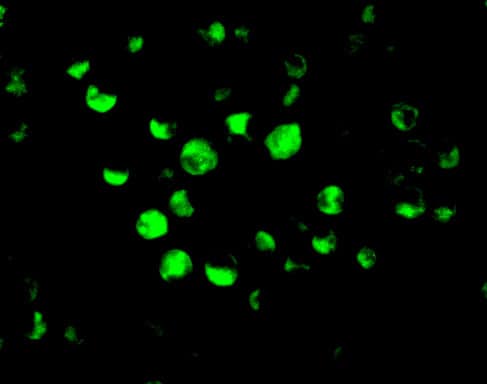
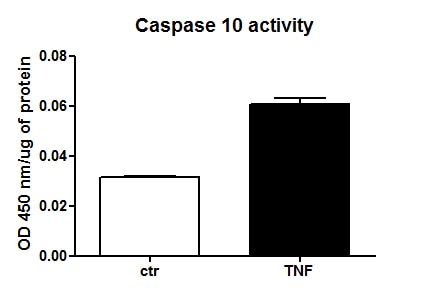
![Caspase-10/FLICE2 Activity Assay Kit (Colorimetric) [NBP2-54829] - The assay was performed on murine insulinoma cell line following Novus' protocol.](http://images.novusbio.com/fullsize/Caspase-10-Activity-Assay-Kit-Colorimetric-NBP2-54829-img0001.jpg "Caspase-10/FLICE2 Activity Assay Kit (Colorimetric) [NBP2-54829] - The assay was performed on murine insulinoma cell line following Novus' protocol.")
| Description | Simple and convenient colorimetric assay to measure Caspase-10 activity in mammalian cells within 1-2 hrs. The assay kit provides a means for assaying the activity of caspases that recognize the sequence AEVD. The assay is based on spectrophotometric detection of the chromophore p-nitroanilide (pNA) after cleavage from the labeled substrate AEVD-pNA.
This product is manufactured by Abcam and distributed by Novus Biologicals. (Abcam Catalog Number: ab65663) |
| Kit Type | Activity Assay Kit (Colorimetric) |
| Gene | CASP10 |
| Reviewed Applications |
|
| Storage | Store at -20C. |




| Images | Ratings | Applications | Species | Date | Details | ||||
|---|---|---|---|---|---|---|---|---|---|
Enlarge |
reviewed by:
Francesca Pacifici |
12/06/2018 |
Summary
Comments
|
Research Areas for Caspase-10/FLICE2 Kit (NBP2-54829)Find related products by research area.
|
|
Caspase 10 - an initiator caspase in the extrinsic death receptor pathway Apoptosis, also called programmed cell death, is an essential process in development and disease. The signaling networks that carry out apoptosis is consists of a series of endoproteases called caspases which are synthesized as inactive zymogens. ... Read full blog post. |


![Immunohistochemistry Caspase-3 Antibody [Unconjugated] - Active](https://images.novusbio.com/images/af835_human-mouse-active-caspase-3-affinity-purified-pab-41202410331943.jpg)
![Western Blot Caspase-3 Antibody [Unconjugated] - Active](https://images.novusbio.com/images/af835_human-mouse-active-caspase-3-affinity-purified-pab-812025554170.jpg)
![Western Blot Caspase-3 Antibody [Unconjugated] - Active](https://images.novusbio.com/images/af835_human-mouse-active-caspase-3-affinity-purified-pab-8120255534731.jpg)
![SDS-Page TNF-alpha [Unconjugated]](https://images.novusbio.com/images/protein/TNF-alpha_210-TA_256.jpg)
![Bioactivity TNF-alpha [Unconjugated]](https://images.novusbio.com/images/protein/TNFalpha_210TA_1658.jpg)
![SEC-MALS TNF-alpha [Unconjugated]](https://images.novusbio.com/images/210-ta_recombinant-human-tnf-alpha-protein-sec-mals-35202312244..jpg)
![TRAIL/TNFSF10 [Unconjugated]](/sites/all/modules/enterprise-tech/et_datasheets/images/novus_guarantee.png "TRAIL/TNFSF10 [Unconjugated]")
![Western Blot FLIP Antibody [Unconjugated]](https://images.novusbio.com/images/af821_human-mouse-flip-affinity-purified-polyclonal-ab-812025557229.jpg)
![Western Blot FLIP Antibody [Unconjugated]](https://images.novusbio.com/images/af821_human-mouse-flip-affinity-purified-polyclonal-ab-812025553471.jpg)
![Western Blot FLIP Antibody [Unconjugated]](https://images.novusbio.com/images/af821_human-mouse-flip-affinity-purified-polyclonal-ab-812025557220.jpg)


![Simple Western BID Antibody [Unconjugated]](https://images.novusbio.com/images/antibody/BID_AF860_Simple_Western_16992.jpg)
![Western Blot BID Antibody [Unconjugated]](https://images.novusbio.com/images/antibody/BID_AF860_Western_Blot_22585.jpg)
![Western Blot BID Antibody [Unconjugated]](https://images.novusbio.com/images/antibody/BID_AF860_Western_Blot_9663.jpg)
![Neutralization TRAILR1/TNFRSF10A Antibody [Unconjugated]](https://images.novusbio.com/images/antibody/TRAIL_R1_AF347_Block_Neutralize_875.jpg)
![Western Blot TRAILR1/TNFRSF10A Antibody [Unconjugated]](https://images.novusbio.com/images/antibody/TRAIL_R1_AF347_Western_Blot_5303.jpg)
![Immunohistochemistry TRAILR1/TNFRSF10A Antibody [Unconjugated]](https://images.novusbio.com/images/antibody/TRAIL_R1_AF347_Immunohistochemistry_17355.jpg)


![N/A Fas Ligand/TNFSF6 [HRP]](https://images.novusbio.com/images/elisa/Fas_Ligand_DFL00_ELISA_94.jpg)
![N/A Fas Ligand/TNFSF6 [HRP]](https://images.novusbio.com/images/elisa/Fas_Ligand_DFL00_ELISA_1192.jpg)
![N/A Fas Ligand/TNFSF6 [HRP]](https://images.novusbio.com/images/elisa/Fas_Ligand_DFL00_ELISA_1193.jpg)