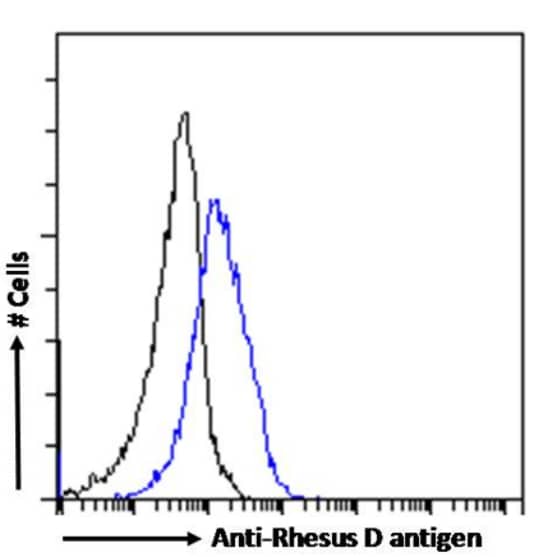
MAB003, open histogram), followed by Phycoerythrin-conjugated Anti-Mouse IgG Secondary Antibody (Catalog # F0102B)." title="Huh-7 human hepatoma cell line was stained with Mouse Anti-Human BCAM Monoclonal Antibody (Catalog # MAB1481, filled histogram) or isotype control antibody (Catalog # MAB003, open histogram), followed by Phycoerythrin-conjugated Anti-Mouse IgG Secondary Antibody (Catalog # F0102B)." />
| Reactivity | HuSpecies Glossary |
| Applications | WB, Flow, CyTOF-ready, ELISA(Cap) |
| Clone | 87207 |
| Clonality | Monoclonal |
| Host | Mouse |
| Conjugate | Unconjugated |
| Concentration | LYOPH |
| Immunogen | Mouse myeloma cell line NS0-derived recombinant human BCAM Glu32-Ala547 Accession # CAA58449 |
| Specificity | Detects human BCAM in ELISAs and Western blots. In Western blots, no cross-reactivity with recombinant human (rh) ALCAM, rhEpCAM, recombinant mouse (rm) MAdCAM-1, rhMCAM, rhNCAM-L1, rmOCAM, or rmTROP‑2 is observed. |
| Source | N/A |
| Isotype | IgG2a |
| Clonality | Monoclonal |
| Host | Mouse |
| Gene | BCAM |
| Purity Statement | Protein A or G purified from hybridoma culture supernatant |
| Innovator's Reward | Test in a species/application not listed above to receive a full credit towards a future purchase. |
| Dilutions |
|
|
| Application Notes | ELISA Detection: Human BCAM Biotinylated Antibody (Catalog number BAF148) Standard: Recombinant Human BCAM Fc Chimera (Catalog number 148-BC) |
|
| Publications |
|
| Storage | Use a manual defrost freezer and avoid repeated freeze-thaw cycles.
|
| Buffer | Lyophilized from a 0.2 μm filtered solution in PBS with Trehalose. *Small pack size (SP) is supplied either lyophilized or as a 0.2 µm filtered solution in PBS. |
| Preservative | No Preservative |
| Concentration | LYOPH |
| Reconstitution Instructions | Reconstitute at 0.5 mg/mL in sterile PBS. |
Basal-Cell Adhesion Molecule (BCAM) and Lutheran blood group glycoprotein (LU) are two alternatively spliced variants of a single immunoglobulin superfamily (IgSF) protein that differ in the length of their cytoplasmic tails. BCAM cDNA encodes a 628 amino acid (aa) residues precursor protein with a putative 31 aa signal peptide, a 597 aa extracellular domain containing three C2 type and two V-type Ig-like domains, a 21 aa transmembrane domain, and a 19 aa cytoplasmic domain. Compared to the 40 aa cytoplasmic domain present in LU, the BCAM cytoplasmic tail lacks the putative Src homology 3 (SH3) binding site that may be involved in mediating intracellular signaling. BCAM/LU has wide tissue distribution and is expressed on erythrocytes, the endothelium of blood vessels and on the basal layer of cells in the epithelia. The expression of BCAM/LU in normal tissues is higher in fetal versus adult tissues. BCAM/LU expression is also upregulated in sickle cell disease red blood cells, in activated keratinocytes and following malignant transformation in some cell types in vivo and in vitro. BCAM/LU has been shown to be an adhesion molecule that binds laminin, a basement membrane protein involved in cell differentiation, adhesion, migration and proliferation.
![Immunohistochemistry ACE/CD143 Antibody [Unconjugated]](https://images.novusbio.com/images/antibody/ACE_AF1513_Immunohistochemistry_6703.jpg)
![Western Blot ACE/CD143 Antibody [Unconjugated]](https://images.novusbio.com/images/antibody/ACE_AF1513_Flow_Cytometry_20028.jpg)
![Simple Western ACE/CD143 Antibody [Unconjugated]](https://images.novusbio.com/images/antibody/ACE_AF1513_Simple_Western_20109.jpg)



Secondary Antibodies |
Isotype Controls |
The concentration calculator allows you to quickly calculate the volume, mass or concentration of your vial. Simply enter your mass, volume, or concentration values for your reagent and the calculator will determine the rest.


![N/A Endothelin-1 [HRP]](https://images.novusbio.com/images/elisa/DATA_Endothelin1_QET00_ELISA_1074.jpg)
![N/A Endothelin-1 [HRP]](https://images.novusbio.com/images/elisa/Endothelin-1_QET00_ELISA_432.jpg)


![Bioactivity IL-2 [Unconjugated]](https://images.novusbio.com/images/202-il_recombinant-human-il-2-protein-bioactivity-174202314946.jpg)


![Bioactivity CTLA-4 [Unconjugated]](https://images.novusbio.com/images/protein/CTLA4_7268CT_2293.jpg)
![SDS-Page TNF-alpha [Unconjugated]](https://images.novusbio.com/images/protein/TNF-alpha_210-TA_256.jpg)
![Bioactivity TNF-alpha [Unconjugated]](https://images.novusbio.com/images/protein/TNFalpha_210TA_1658.jpg)
![SEC-MALS TNF-alpha [Unconjugated]](https://images.novusbio.com/images/210-ta_recombinant-human-tnf-alpha-protein-sec-mals-35202312244..jpg)

![Flow Cytometry MCAM/CD146 Antibody (128018) [Unconjugated]](https://images.novusbio.com/images/antibody/MCAM_MAB932_Flow_Cytometry_23871.jpg)
![Western Blot MCAM/CD146 Antibody (128018) [Unconjugated]](https://images.novusbio.com/images/antibody/MCAM_MAB932_Western_Blot_19349.jpg)