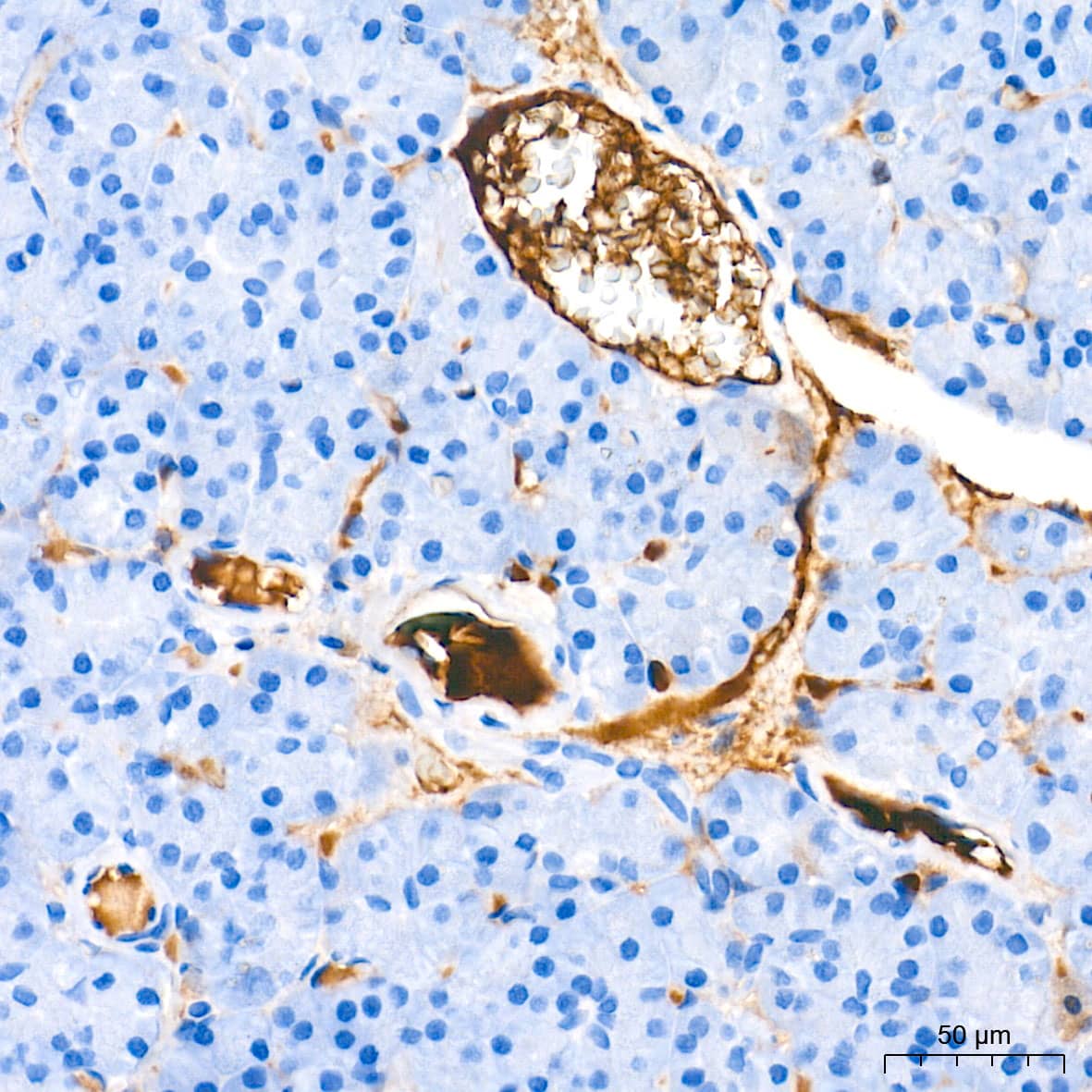
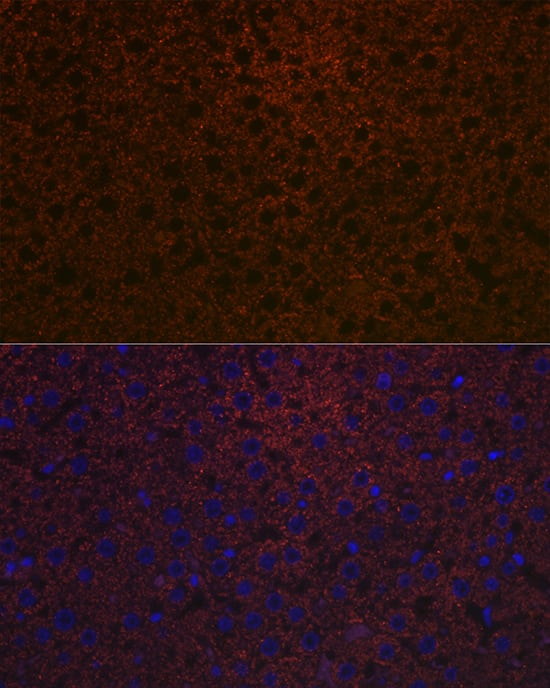
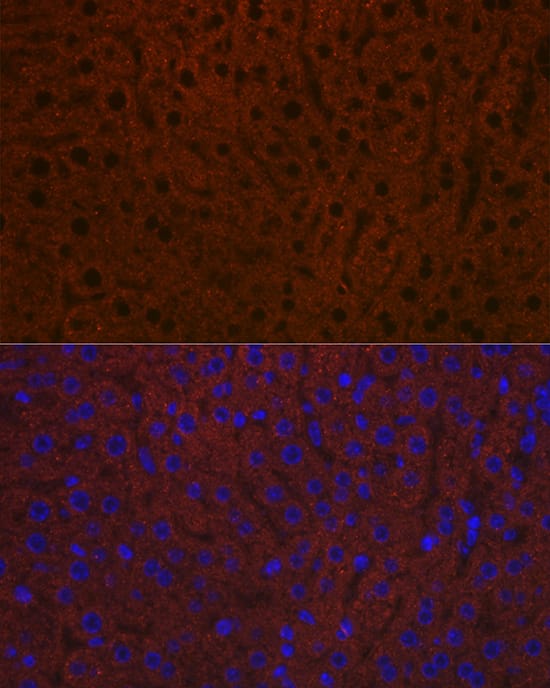
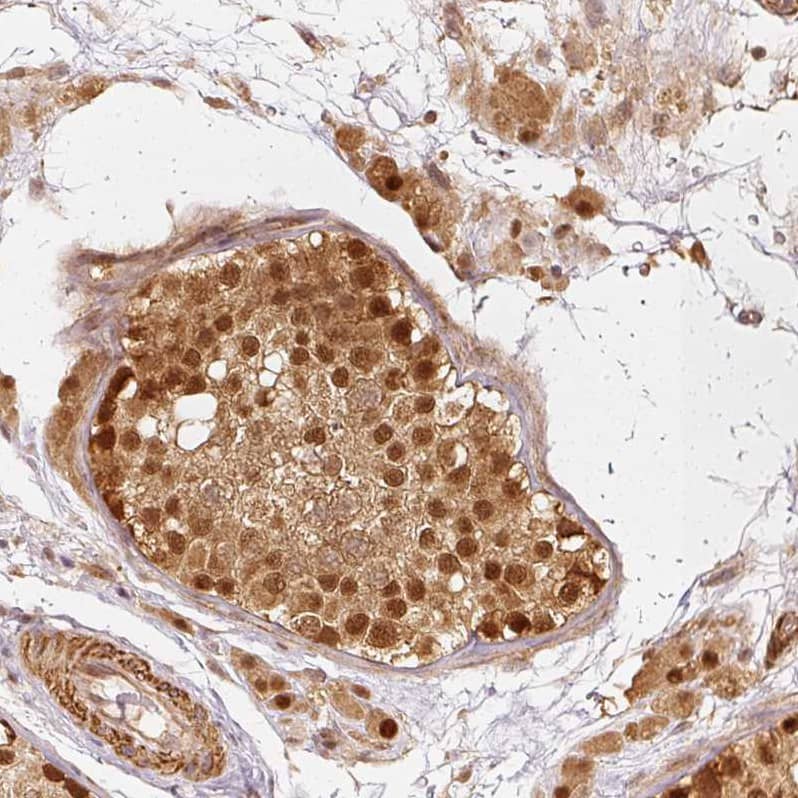
PSME4 Knockout HeLa Cell Lysate

Images


Product Details

Summary
Product Discontinued
View other related PSME4 Lysates

Order Details


    • Catalog Number
      NBP2-77278
    • Availability
      Product Discontinued

    Can't find what you are looking for? Use our Antibody Concierge Service & we will help you locate your antibody!

    Or feel free to contact us for alternative products.

PSME4 Knockout HeLa Cell Lysate Summary

Preparation
Method
Knockout achieved by using CRISPR/Cas9
Gene
PSME4

Applications/Dilutions

Dilutions
  • Western Blot
Application Notes
You will receive 1 vial (100ug) of knockout cell lysate and 1 vial (100ug) of Parental cell lysate. Lysate can be diluted with 1X SDS sample buffer and will be stable at -20 degrees C for 12 months. Minimize freeze-thaw cycles.

Packaging, Storage & Formulations

Storage
Store at -20C short term. Aliquot and store at -80C long term. Avoid freeze-thaw cycles.
Buffer
0.1 mg cell homogenate lyophilized in RIPA buffer made with double-knockout cell lines.
Concentration
LYOPH
Reconstitution Instructions
To use as WB negative control, spin down briefly and resuspend in 100 uL 1xSDS sample buffer (2% SDS, 60 mM Tris-HCl pH 6.8, 10% Glycerol, 0.02% Bromophenol blue, 60 mM beta-mercaptoethanol). Boil the lysate for 3 - 5 minutes before loading it onto gel.

Lysate Details for Array

Type
Knockout HeLa Cell

Notes

Powered by EDIGENE.
Validation of antibody specificity is critical and verification of antibody performance against knockout samples is one way to guarantee that an antibody recognizes a specific target. Novus' KO cell lysate can be used as a negative control for western blots and to confirm the specificity of antibodies.

Alternate Names for PSME4 Knockout HeLa Cell Lysate

  • proteasome (prosome, macropain) activator subunit 4

Background

Proteolytic degradation is critical to the maintenance of appropriate levels of short-lived and regulatory proteins as important and diverse as those involved in cellular metabolism, heat shock and stress response, antigen presentation, modulation of cell surface receptors and ion channels, cell cycle regulation, transcription, and signalling factors. The ubiquitin-proteasome pathway deconstructs most proteins in the eukaryotic cell cytosol and nucleus. Other proteins are degraded via the vacuolar pathway which includes endosomes, lysosomes, and the endoplasmic reticulum. The 26S proteasome is an ATP-dependent, multisubunit (~31), barrel-shaped molecular machine with an apparent molecular weight of ~2.5 MDa. It consists of a 20S proteolytic core complex which is crowned at one or both ends by 19S regulatory subunit complexes. The 19S regulatory subunits recognize ubiquitinated proteins and play an essential role in unfolding and translocating targets into the lumen of the 20S subunit. The PA28/11S REG Activator protein complex functions as a proteolytic activator. PA200 has been identified as a 200 kDa nuclear protein that activates the 26S proteasome complex. Studies have shown that, in human tissues, PA200 mRNA levels are highest in testis, but is also present in liver, spleen, brain, heart, kidney and lung. Evidence suggests that this protein is involved in DNA repair, possibly by recruiting the proteasome to double-strand DNA breaks.

Limitations

This product is for research use only and is not approved for use in humans or in clinical diagnosis. Lysates are guaranteed for 6 months from date of receipt.

Customers Who Viewed This Item Also Viewed...

NBP3-15868
Species: Hu, Mu, Rt
Applications: ELISA, ICC/IF, IHC,  IHC-P, WB
NBP1-87799
Species: Hu, Mu, Rt
Applications: ICC/IF, IHC,  IHC-P, WB
NB100-1483
Species: Hu, Mu, Rt
Applications: Flow, ICC/IF, PEP-ELISA, PLA, WB
NBP1-83121
Species: Hu
Applications: IHC,  IHC-P, Simple Western, WB
NBP2-01294
Species: Ca, Hu, Pm, Mu, Pm, Rt
Applications: Flow, ICC/IF, IHC,  IHC-P, WB
MAB6734
Species: Hu
Applications: IHC
NBP1-33498
Species: Hu, Mu, Rt
Applications: ICC/IF, IHC,  IHC-P, KO, WB
NB100-1595
Species: Hu, Mu
Applications: IHC,  IHC-P, IP, WB
NBP2-38323
Species: Hu
Applications: ICC/IF, IHC,  IHC-P, WB
NB600-1049
Species: Hu, Mu, Rt
Applications: ICC/IF, IHC,  IHC-P, WB
NBP2-19952
Species: Hu
Applications: ICC/IF, KD, WB
NB100-1178
Species: Hu, Mu, Rt
Applications: Flow-IC, ICC/IF, PEP-ELISA, WB
NBP1-88660
Species: Hu
Applications: ICC/IF, IHC,  IHC-P, WB
NBP2-01817
Species: Hu, Mu, Rt
Applications: Flow, ICC/IF, IHC,  IHC-P, WB
DCX900
Species: Hu
Applications: ELISA
NBP3-32868
Species: Hu, Mu, Rt
Applications: Flow, ICC/IF, IHC,  IHC-P, WB
H00027244-B01P
Species: Hu
Applications: ICC/IF, WB
AF5945
Species: Hu, Mu, Rt
Applications: WB

Publications for PSME4 Lysate (NBP2-77278) (0)

There are no publications for PSME4 Lysate (NBP2-77278).
By submitting your publication information earn gift cards and discounts for future purchases.

Reviews for PSME4 Lysate (NBP2-77278) (0)

There are no reviews for PSME4 Lysate (NBP2-77278). By submitting a review you will receive an Amazon e-Gift Card or Novus Product Discount.
  • Review with no image -- $10/€7/£6/$10 CAD/¥70 Yuan/¥1110 Yen
  • Review with an image -- $25/€18/£15/$25 CAD/¥150 Yuan/¥2500 Yen

Product General Protocols

Find general support by application which include: protocols, troubleshooting, illustrated assays, videos and webinars.

Video Protocols

WB Video Protocol

FAQs for PSME4 Lysate (NBP2-77278) (0)

There are no specific FAQs related to this product. Read our general customer & technical service FAQs.

Additional PSME4 Products

Array NBP2-77278

Research Areas for PSME4 Lysate (NBP2-77278)

Find related products by research area.

Blogs on PSME4

There are no specific blogs for PSME4, but you can read our latest blog posts.

Contact Information

Product PDFs

Calculators

Concentration Calculator

The concentration calculator allows you to quickly calculate the volume, mass or concentration of your vial. Simply enter your mass, volume, or concentration values for your reagent and the calculator will determine the rest.

=
÷

Review this Product

Be the first to review our PSME4 Knockout HeLa Cell Lysate and receive a gift card or discount.

Bioinformatics

Gene Symbol PSME4