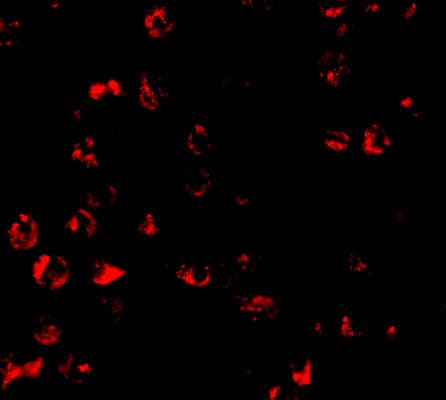
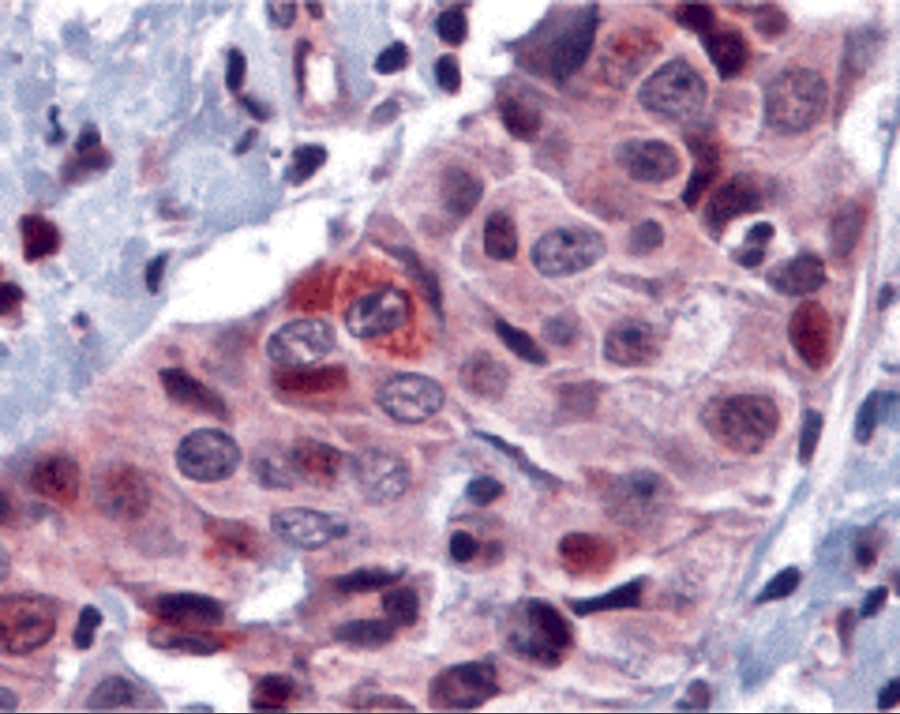
![Western Blot: p73 Antibody [NB100-56435] - Analysis of p73 in A) transfected cell lysate and B) HeLa cell lysate using this antibody.](http://images.novusbio.com/fullsize/p73-Antibody-Western-Blot-NB100-56435-img0002.jpg "Western Blot: p73 Antibody [NB100-56435] - Analysis of p73 in A) transfected cell lysate and B) HeLa cell lysate using this antibody.")
| Immunogen | A synthetic peptide CTHSPYAQPSS corresponding to amino acids 95-104 of human p73 was used as immunogen. |
| Specificity | This peptide sequence is 100% conserved across multiple p73 isoforms and between rat, mouse, dog and bovine p73. Researchers are encourage to use the the immunogen sequence information and available Bioinformatics data bases to obtain additional information regarding the amino acid sizes associated with various p73 isoforms. |
| Isotype | IgG |
| Clonality | Polyclonal |
| Host | Rabbit |
| Gene | TP73 |
| Purity | Immunogen affinity purified |
| Innovator's Reward | Test in a species/application not listed above to receive a full credit towards a future purchase. |
| Dilutions |
|
||
| Application Notes | Caspase-cleaved p73 fragments, including 55 kDa and 45 kDa, have been described (Sayan et al, 2008). The ability of a given antibody to recognize a p73 fragment will depend on whether or not the antibody epitope is contained in the fragment. As p73 research continues to evolve, researchers are encouraged to refer to the published literature using the p73 antibodies to gain additional information. In Simple Western only 10 - 15 uL of the recommended dilution is used per data point. Separated by Size-Wes, Sally Sue/Peggy Sue. |
||
| Control |
|
| Storage | Store at 4C short term. Aliquot and store at -20C long term. Avoid freeze-thaw cycles. |
| Buffer | PBS containing 0.2% gelatin |
| Preservative | 0.05% Sodium Azide |
| Concentration | 0.5 mg/ml |
| Purity | Immunogen affinity purified |






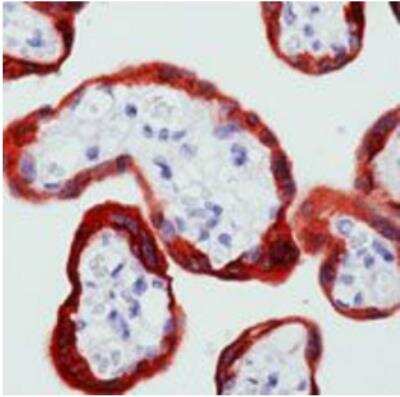


![Immunohistochemistry PAK3 Antibody [Unconjugated]](https://images.novusbio.com/images/antibody/PAK3_AF6897_Immunohistochemistry_11144.jpg)
![Simple Western PAK3 Antibody [Unconjugated]](https://images.novusbio.com/images/antibody/af6897_human-mouse-pak3-affinity-purified-polyclonal-ab-simple-western-245202494437..jpg)
![Immunohistochemistry PAK3 Antibody [Unconjugated]](https://images.novusbio.com/images/antibody/PAK3_AF6897_Immunohistochemistry_11480.jpg)


Secondary Antibodies |
Isotype Controls |
Research Areas for p73 Antibody (NB100-56435)Find related products by research area.
|
|
p73: An Important Tumor Suppressor Cousin of p53 p73 has been identified as a long-lost cousin of the p53 tumor suppressor protein. It has high homology with both p53 and with p63, a gene implicated in the maintenance of epithelial stem cells. The presence of significant homology between the DNA-bin... Read full blog post. |
The concentration calculator allows you to quickly calculate the volume, mass or concentration of your vial. Simply enter your mass, volume, or concentration values for your reagent and the calculator will determine the rest.


![Western Blot: p73 Antibody [NB100-56435] - Western blot analysis of HeLa cell lysate (nuclear fraction) using p73 antibody at 3 ug/ml.](http://images.novusbio.com/fullsize/p73-Antibody-Western-Blot-NB100-56435-img0003.jpg "Western Blot: p73 Antibody [NB100-56435] - Western blot analysis of HeLa cell lysate (nuclear fraction) using p73 antibody at 3 ug/ml.")
![Simple Western: p73 Antibody [NB100-56435] - Simple Western lane view shows a specific band for p73 in 1.0 mg/ml of HeLa lysate. This experiment was performed under reducing conditions using the 12-230 kDa separation system.](http://images.novusbio.com/fullsize/p73-Antibody-Simple-Western-NB100-56435-img0004.jpg "Simple Western: p73 Antibody [NB100-56435] - Simple Western lane view shows a specific band for p73 in 1.0 mg/ml of HeLa lysate. This experiment was performed under reducing conditions using the 12-230 kDa separation system.")
![Immunohistochemistry p63/TP73L Antibody [Unconjugated]](https://images.novusbio.com/images/antibody/p63_AF1916_Immunohistochemistry_16919.jpg)
![Immunocytochemistry/ Immunofluorescence p63/TP73L Antibody [Unconjugated]](https://images.novusbio.com/images/antibody/af1916_human-p63-tp73l-affinity-purified-polyclonal-ab-2362025103050.jpg)
![Western Blot p63/TP73L Antibody [Unconjugated]](https://images.novusbio.com/images/antibody/af1916_human-p63-tp73l-affinity-purified-polyclonal-ab-western-blot-41202413135..jpg)
![Simple Western CKAP4/p63 Antibody [Unconjugated]](https://images.novusbio.com/images/antibody/af7355_human-ckap4-p63-affinity-purified-polyclonal-ab-simple-western-157202493849.jpg)
![Western Blot CKAP4/p63 Antibody [Unconjugated]](https://images.novusbio.com/images/antibody/CKAP4_AF7355_Western_Blot_11997.jpg)
![Immunocytochemistry CKAP4/p63 Antibody [Unconjugated]](https://images.novusbio.com/images/antibody/CKAP4_AF7355_Immunocytochemistry__Immunofluorescence_17000.jpg)


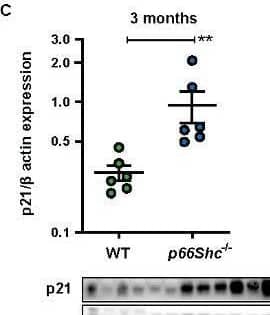
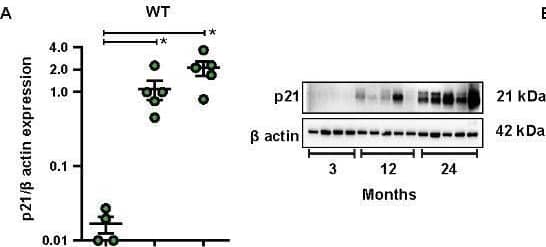
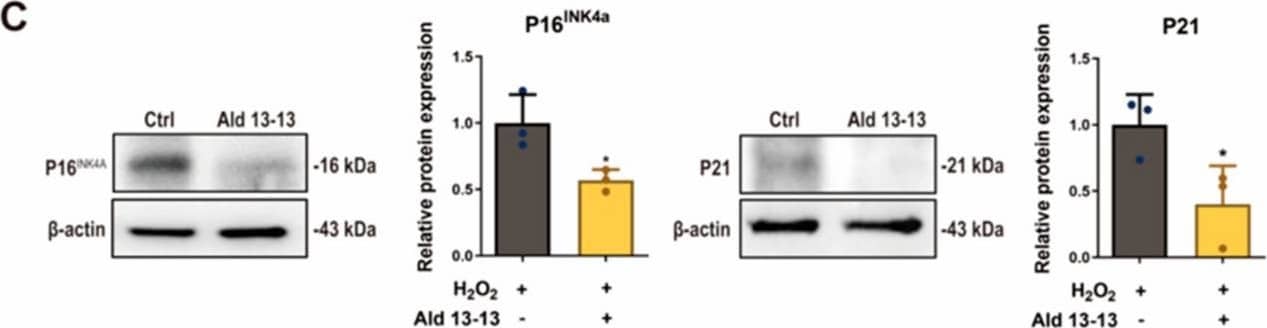


![Western Blot RB1 Antibody (607121) [Unconjugated]](https://images.novusbio.com/images/mab6495_human-rb1-mab-clone-607121-812025548577.jpg)
![Simple Western RB1 Antibody (607121) [Unconjugated]](https://images.novusbio.com/images/antibody/RB1_MAB6495_Simple_Western_16629.jpg)
![Western Blot RB1 Antibody (607121) [Unconjugated]](https://images.novusbio.com/images/antibody/RB1_MAB6495_Western_Blot_10216.jpg)