| Details of Functionality | Measured by its ability to cleave the fluorogenic peptide substrate Ac-VDVAD-AFC. The specific activity is >1000 pmol/min/µg, as measured under the described conditions. |
| Source | E. coli-derived human Caspase-2 protein Gly170-Asp333 & Ala348-Tyr452 |
| Accession # | |
| N-terminal Sequence | Gly170 & Ala348 |
| Protein/Peptide Type | Recombinant Enzymes |
| Gene | CASP2 |
| Purity | >95%, by SDS-PAGE under reducing conditions and visualized by silver stain |
| Endotoxin Note | <1.0 EU per 1 μg of the protein by the LAL method. |
| Dilutions |
|
|
| Theoretical MW | 12 kDa & 18 kDa. Disclaimer note: The observed molecular weight of the protein may vary from the listed predicted molecular weight due to post translational modifications, post translation cleavages, relative charges, and other experimental factors. |
|
| SDS-PAGE | 10 kDa & 17 kDa, reducing conditions |
|
| Publications |
|
| Storage | Use a manual defrost freezer and avoid repeated freeze-thaw cycles.
|
|||
| Buffer | Supplied as a 0.2 μm filtered solution in HEPES, NaCl, DTT and Sucrose with BSA as a carrier protein. |
|||
| Purity | >95%, by SDS-PAGE under reducing conditions and visualized by silver stain |
|||
| Assay Procedure |
*Adjusted for Substrate Blank
|
Caspase-2 (Cysteine-aspartic acid protease 2/Casp2; also NEDD2 and ICH-1) is a 30‑32 kDa member of the peptidase C14A/IL‑1 beta ‑converting family of enzymes (1‑3). It is widely expressed and is an integral component of the apoptotic cascade. Based on the length of its prodomain, caspase-2 has been considered to be an initiator caspase. However, studies have shown that other caspases (such as Casp 3) activate procaspase 2, and Caspase-2 likely acts on key cellular molecules such as BID, Golgin 160 and DFF45/ICAD (2, 4, 5). Thus, Caspase-2 is perhaps more likely to be a specialized executioner caspase. Human procaspase-2 is a 48‑51 kDa, 452 amino acid (aa) protein (4‑7). It is known to exist as a disulfide-linked homodimer via covalent linkage at Cys436 (2, 5). But this dimeric state may not be sufficient for (auto)activation. Actual activation may occur following oligomerization within the context of activating platforms such as DISC (death-inducing signaling complex) or the PIDDosome (8‑10). Initially, procaspase-2 undergoes proteolytic cleavage to generate an N-terminal 333 aa p34/34 kDa subunit, and a 119 aa C-terminal p14/14 kDa subunit (5). The p34 and p14 subunits are further processed to generate the prodomain (aa 1‑169), plus the mature p18 (aa 170‑333) and p12 (aa 348‑452) subunits (4‑6). Notably, each p18:p12 noncovalent heterodimer demonstrates proteolytic activity around a catalytic site at aa 318‑322, and, due to an nuclear localization signal within the prodomain, may be found in either nucleus or cytoplasm (11, 12). There are multiple potential isoform variants. Individually, or in combination, there is an alternative start site at Met18, a substitution of two aa for aa 107‑452, a second substitution of 14 aa for aa 309‑322, and a third substitution of 22 aa for aa 323‑452 (6, 7, 13). The human and mouse procaspase 2 precursors are 90% aa identical, with the majority of differences lying in the prodomain.


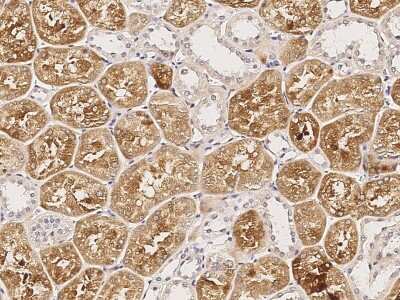
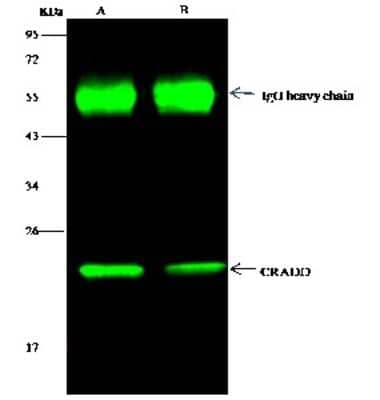
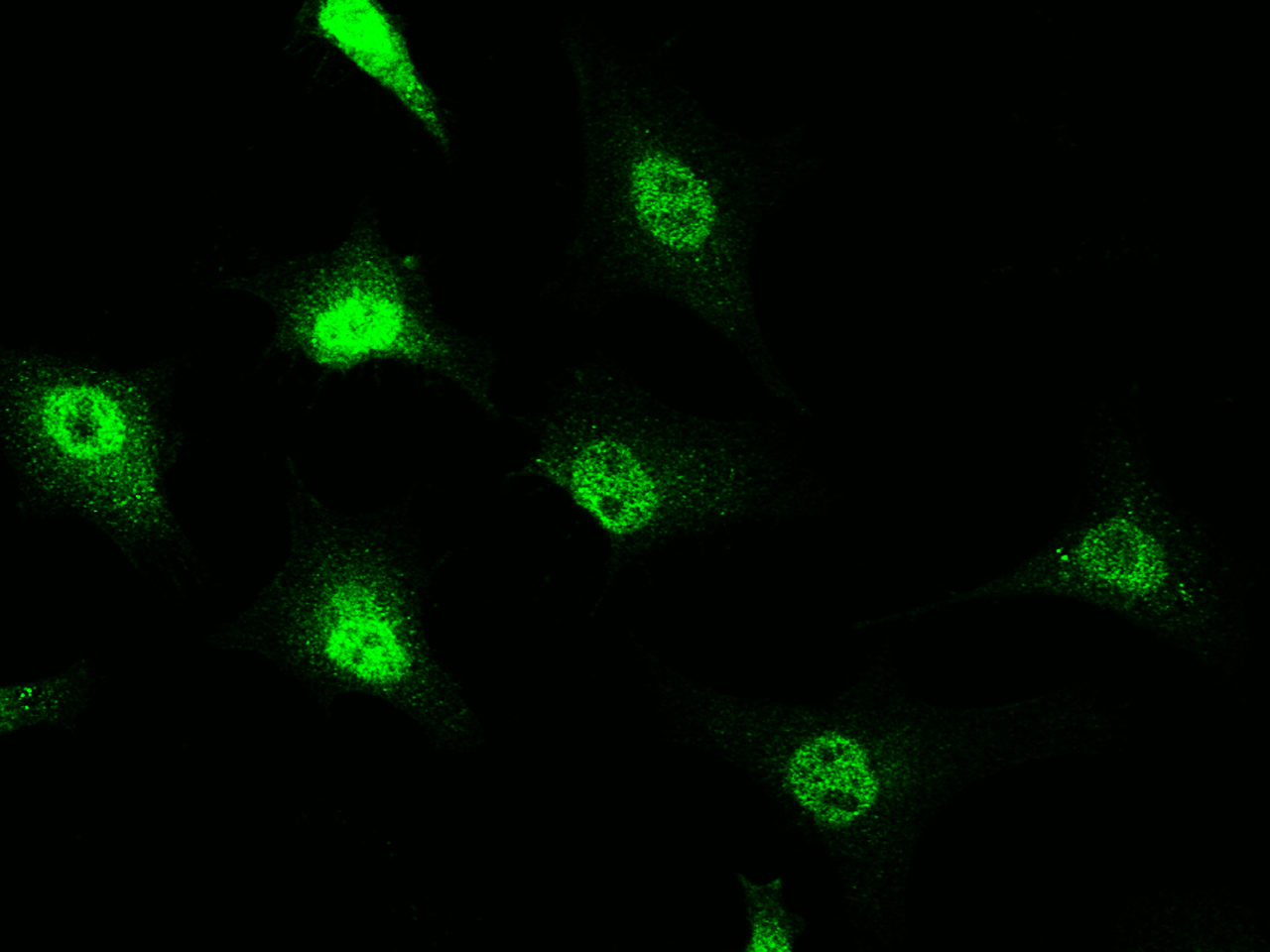
|
Pyroptosis: Mechanisms mediating cell death and pro-inflammatory cytokine release By Victoria OsinskiPyroptosis is an inflammatory form of programmed cell death characterized by the release of pro-inflammatory cytokines IL-1 beta and IL-18.1,10 It is a process distinct from apoptosis and necrosis (T... Read full blog post. |
|
active/cleaved Caspase 2 - Inducing apoptosis in response to cellular stress Caspase-2 is a highly conserved member of the caspase family involved in the initiation and execution of apoptosis. While its function is still poorly understood, caspase-2 is thought to be important for apoptosis in response to DNA damage, bacteri... Read full blog post. |
|
IRE1 - an important sensor in the unfolded protein response pathway During cellular stress the protein folding capacity of the ER is diminished. In order to maintain homeostasis and ensure proper protein folding cells activate the unfolded protein response (UPR), a signaling network consisting of sensors and effect... Read full blog post. |
The concentration calculator allows you to quickly calculate the volume, mass or concentration of your vial. Simply enter your mass, volume, or concentration values for your reagent and the calculator will determine the rest.


![Immunohistochemistry Caspase-3 Antibody [Unconjugated] - Active](https://images.novusbio.com/images/af835_human-mouse-active-caspase-3-affinity-purified-pab-41202410331943.jpg)
![Western Blot Caspase-3 Antibody [Unconjugated] - Active](https://images.novusbio.com/images/af835_human-mouse-active-caspase-3-affinity-purified-pab-812025554170.jpg)
![Western Blot Caspase-3 Antibody [Unconjugated] - Active](https://images.novusbio.com/images/af835_human-mouse-active-caspase-3-affinity-purified-pab-8120255534731.jpg)


![Simple Western Bax Antibody [Unconjugated]](https://images.novusbio.com/images/antibody/Bax_AF820_Simple_Western_23759.jpg)
![Immunohistochemistry Bax Antibody [Unconjugated]](https://images.novusbio.com/images/antibody/Bax_AF820_Immunohistochemistry_7090.jpg)
![Immunocytochemistry Bax Antibody [Unconjugated]](https://images.novusbio.com/images/antibody/Bax_AF820_Immunocytochemistry__Immunofluorescence_22092.jpg)
![Simple Western BID Antibody [Unconjugated]](https://images.novusbio.com/images/antibody/BID_AF860_Simple_Western_16992.jpg)
![Western Blot BID Antibody [Unconjugated]](https://images.novusbio.com/images/antibody/BID_AF860_Western_Blot_22585.jpg)
![Western Blot BID Antibody [Unconjugated]](https://images.novusbio.com/images/antibody/BID_AF860_Western_Blot_9663.jpg)
![Immunoprecipitation bcl-x Antibody [Unconjugated]](https://images.novusbio.com/images/antibody/Bcl-x_AF800_Immunoprecipitation_1612.jpg)
![Simple Western bcl-x Antibody [Unconjugated]](https://images.novusbio.com/images/antibody/Bclx_AF800_Simple_Western_16514.jpg)
![Western Blot bcl-x Antibody [Unconjugated]](https://images.novusbio.com/images/af800_human-mouse-bcl-x-affinity-purified-polyclonal-ab-western-blot-12122025825244.jpg)
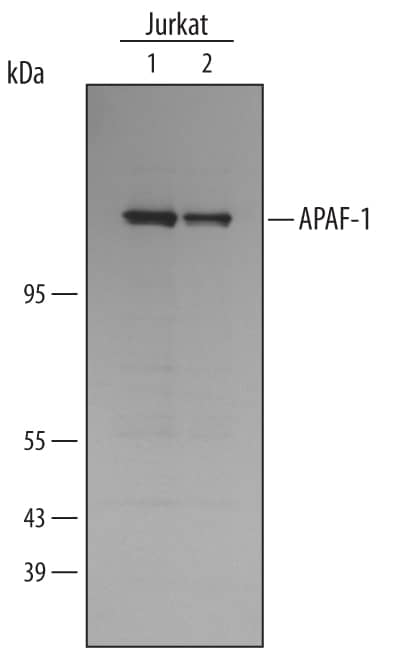


![SDS-Page TNF-alpha [Unconjugated]](https://images.novusbio.com/images/protein/TNF-alpha_210-TA_256.jpg)
![Bioactivity TNF-alpha [Unconjugated]](https://images.novusbio.com/images/protein/TNFalpha_210TA_1658.jpg)
![SEC-MALS TNF-alpha [Unconjugated]](https://images.novusbio.com/images/210-ta_recombinant-human-tnf-alpha-protein-sec-mals-35202312244..jpg)


