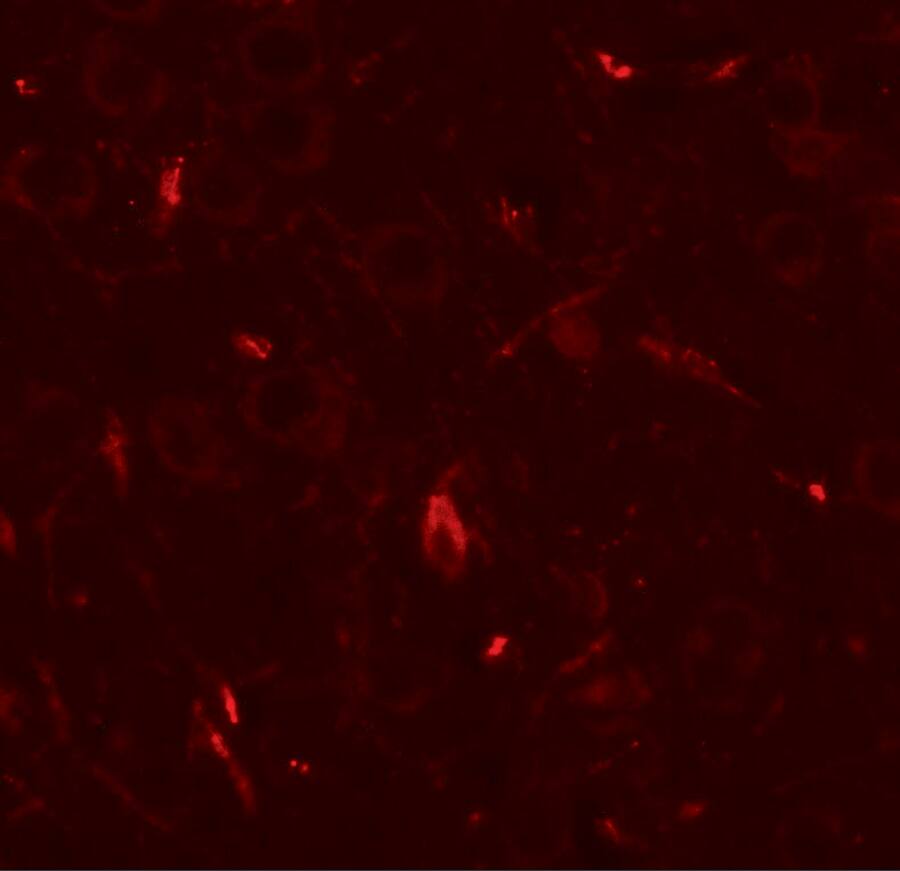
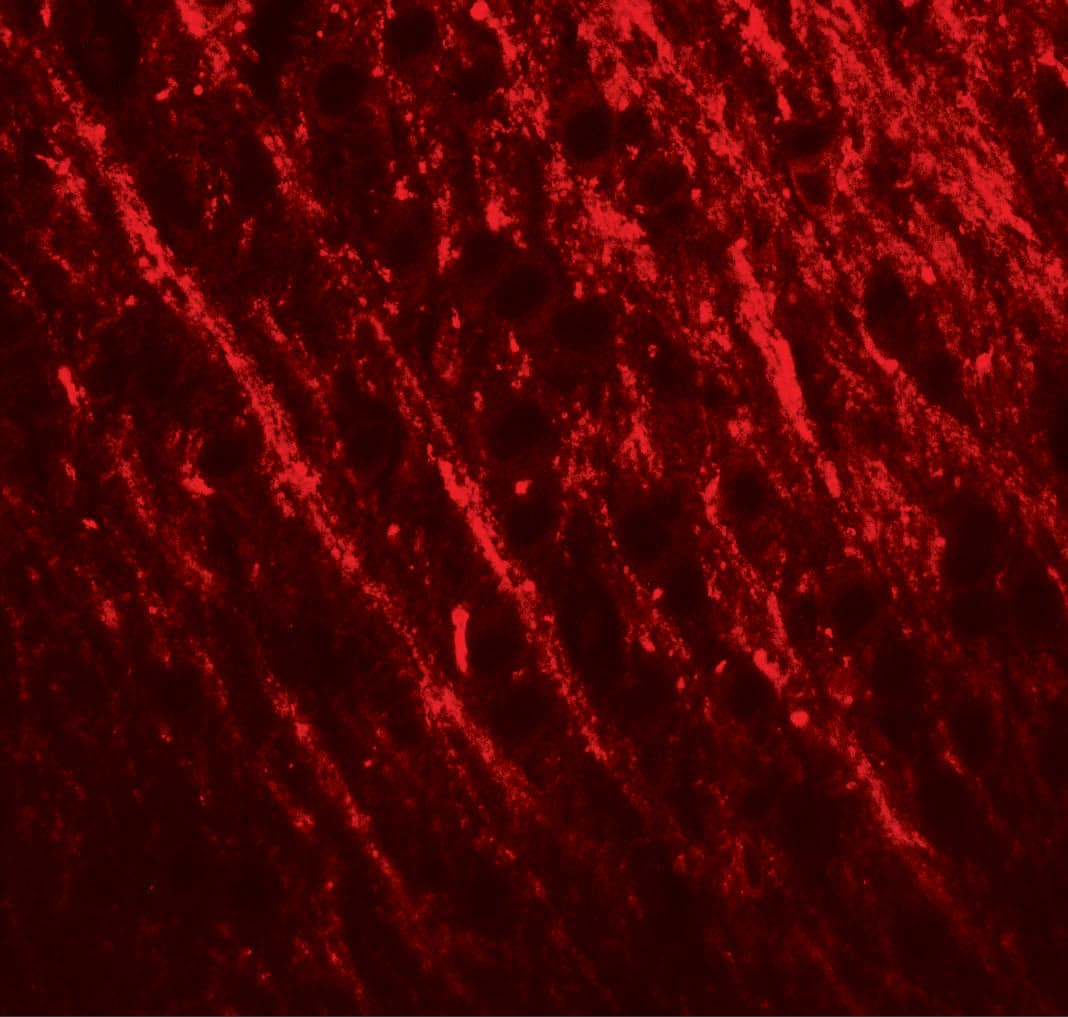
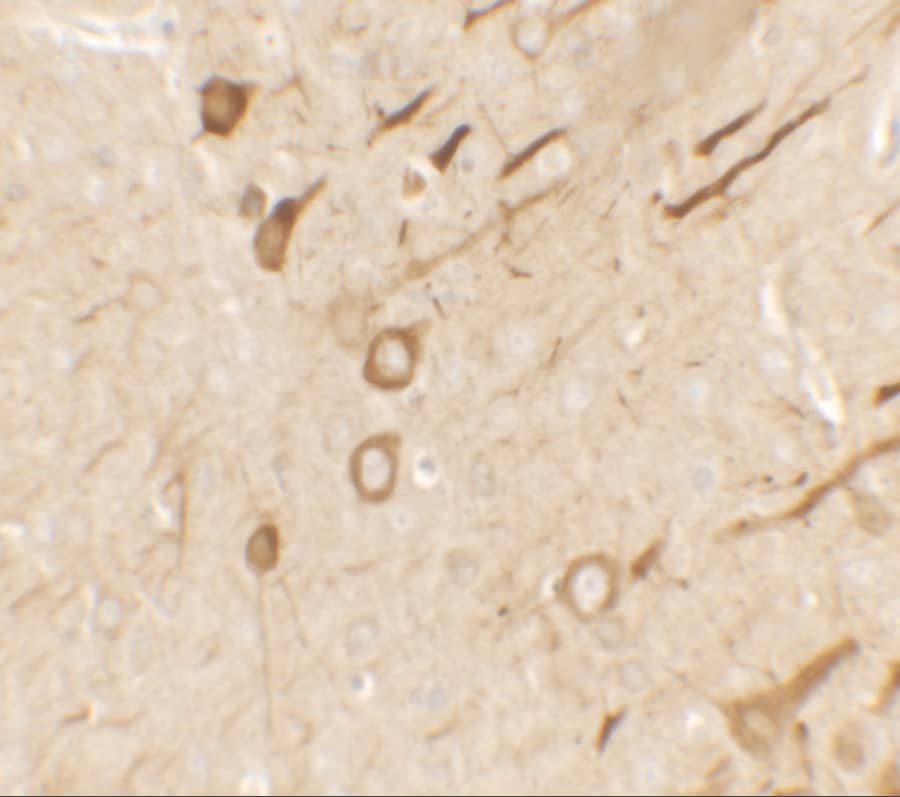
PICK1 Antibody (S20-8) Summary
| Immunogen |
Fusion protein amino acids 101-30 of rat PICK1, accession number AAG48152. |
| Localization |
Cytoplasm (perinuclear region) , Cell Junction |
| Specificity |
Approximately 45 kDa. |
| Isotype |
IgG2a |
| Clonality |
Monoclonal |
| Host |
Mouse |
| Gene |
PICK1 |
| Purity |
Protein G purified |
| Innovator's Reward |
Test in a species/application not listed above to receive a full credit towards a future purchase. |
Applications/Dilutions
| Dilutions |
- Immunohistochemistry 1:10-1:500
- Immunohistochemistry-Frozen 1:10-1:500
- Immunohistochemistry-Paraffin 0.1-1.0 ug/ml
- Immunoprecipitation 1:10-1:500
- Western Blot 1 ug/ml
|
Reactivity Notes
Human, Mouse, Rat. Please note that this antibody is reactive to Mouse and derived from the same host, Mouse. Additional Mouse on Mouse blocking steps may be required for IHC and ICC experiments. Please contact Technical Support for more information.
Packaging, Storage & Formulations
| Storage |
Store at -20C. Avoid freeze-thaw cycles. |
| Buffer |
PBS (pH 7.4) and 50% Glycerol |
| Preservative |
0.09% Sodium Azide |
| Concentration |
1 mg/ml |
| Purity |
Protein G purified |
Alternate Names for PICK1 Antibody (S20-8)
Background
Ion channels are integral membrane proteins that help establish and control the small voltage gradient across the plasma membrane of living cells by allowing the flow of ions down their electrochemical gradient (1). They are present in the membranes that surround all biological cells because their main function is to regulate the flow of ions across this membrane. Whereas some
ion channels permit the passage of ions based on charge, others conduct based on a ionic species, such as sodium or potassium. Furthermore, in some ion channels, the passage is governed by a gate which is controlled by chemical or electrical signals, temperature, or mechanical forces. There are a few main classifications of gated ion channels. There are voltage- gated ion channels, ligandgated, other gating systems and finally those that are classified differently, having more exotic characteristics. The first are voltage- gated ion channels which open and close in response to membrane potential. These are then separated into sodium, calcium, potassium, proton, transient receptor, and cyclic nucleotide-gated channels; each of which is responsible for a unique role. Ligand-gated ion channels are also known as ionotropic receptors, and they open in response to specific ligand molecules binding to the extracellular domain of the receptor protein. The other gated classifications include activation and inactivation by second messengers, inward-rectifier potassium channels, calcium-activated potassium channels, two-pore-domain potassium channels, light-gated channels, mechano-sensitive ion channels and cyclic nucleotide-gated channels. Finally, the other classifications are based on less normal characteristics such as two-pore channels, and transient receptor potential channels (2). PRKCA-binding protein is a protein that is encoded by the Pick1 gene (3, 4). The protein encoded by this gene contains a PSD domain, which interacts with protein kinase C, alpha. The protein functions as an adaptor that binds to and organizes subcellular localization of a variety of membrane proteins. It has been shown to interact with multiple glutamate receptor subtypes, monoamine plasma membrane transporters, and non-voltage gated sodium channels. This protein has also been found to act as an anchoring protein that specifically targets PRKCA to mitochondria in a ligand-specific manner (5).
Limitations
This product is for research use only and is not approved for use in humans or in clinical diagnosis. Primary Antibodies are
guaranteed for 1 year from date of receipt.
Customers Who Viewed This Item Also Viewed...
Species: Hu, Mu, Rt
Applications: ICC/IF, IHC, IHC-P, IP, WB
Species: Bt, Bv, Ca, Ha, Hu, Mu, Po, Rb, Rt
Applications: ICC, IHC, IHC-P, WB
Species: Hu, Mu, Rt
Applications: ELISA, ICC/IF, IHC, IHC-P, WB
Species: Hu, Mu, Rt
Applications: ELISA, ICC/IF, IHC, IHC-P, WB
Species: Hu, Mu
Applications: ICC/IF, IHC, IHC-P, WB
Species: Hu, Rt
Applications: ICC/IF, IHC, IHC-P, WB
Species: Hu, In, Mu, Pm, Rt
Applications: B/N, ChIP, Flow, ICC/IF, IHC, IHC-Fr, IHC-P, IP, WB
Species: Hu
Applications: ELISA
Species: Hu, Mu, Po, Rt
Applications: ICC/IF, IHC, IHC-P, WB
Species: Hu, Mu, Rt
Applications: ICC/IF, IHC, WB
Species: Hu
Applications: IHC, IHC-P, WB
Species: Hu
Applications: IHC, WB
Species: Hu, Mu
Applications: IHC, IHC-P, WB
Species: Bv, Hu
Applications: ICC, IHC, IHC-P, WB
Species: Hu, Mu, Rt
Applications: ICC/IF, IHC, WB
Species: Hu, In, Mu, Pm, Rt
Applications: B/N, ChIP, Flow, ICC/IF, IHC, IHC-Fr, IHC-P, IP, WB
Publications for PICK1 Antibody (NBP1-49572) (0)
There are no publications for PICK1 Antibody (NBP1-49572).
By submitting your publication information earn gift cards and discounts for future purchases.
Reviews for PICK1 Antibody (NBP1-49572) (0)
There are no reviews for PICK1 Antibody (NBP1-49572).
By submitting a review you will receive an Amazon e-Gift Card or Novus Product Discount.
- Review with no image -- $10/€7/£6/$10 CAD/¥70 Yuan/¥1110 Yen
- Review with an image -- $25/€18/£15/$25 CAD/¥150 Yuan/¥2500 Yen
Product General Protocols
Find general support by application which include: protocols, troubleshooting, illustrated assays, videos and webinars.
Video Protocols
FAQs for PICK1 Antibody (NBP1-49572). (Showing 1 - 1 of 1 FAQ).
-
Here is a difficult request. We are looking for an antibody with the following specifications: Anti-PICK1 Reactive in mouse without sodium azide, so it can be injected into the mouse without compromising its life With PBS (for example) It does not necessarily have to be guaranteed. Have you got anything like it?
- Unfortunately all of our anti-PICK1 mouse-reactive antibodies are supplied in sodium azide. We do have anti human PICK1 without preservatives, but that would not be suitable if you are working with mouse samples. NB100-41403 contains only 0.02% sodium azide which is the lowest percentage. We also offer an Antibody Concentration and Clean Up Antibody Purification Kit which can be used to reduce the concentration of unwanted additives often found in antibody formulations, such as sodium azide, glycine or tris. This kit is offered in two sizes: cat# 861-0005 includes 1 column and cat# 861-0010 includes 3 columns.
Secondary Antibodies
| |
Isotype Controls
|
Additional PICK1 Products
Research Areas for PICK1 Antibody (NBP1-49572)
Find related products by research area.
|
Blogs on PICK1