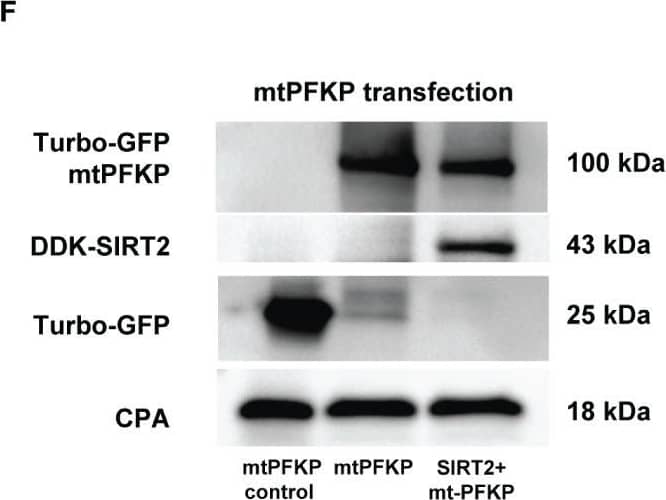
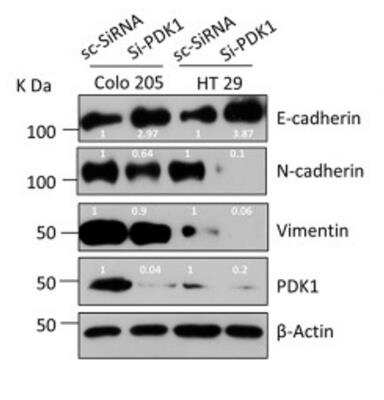
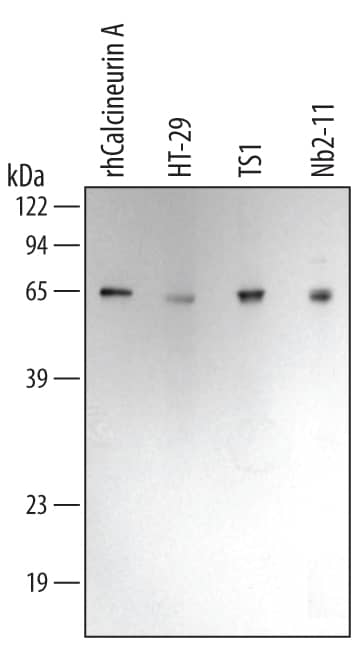
HAF007). A specific band was detected for Calcineurin B at approximately 18 kDa (as indicated). This experiment was conducted under reducing conditions and using Immunoblot Buffer Group 3." title="Western blot shows lysates of MCF-7 human breast cancer cell line, TS1 mouse helper T cell line, and PC-12 rat adrenal pheochromocytoma cell line. PVDF membrane was probed with 0.5 µg/mL of Human/Mouse/Rat Calcineurin B Monoclonal Antibody (Catalog # MAB1348) followed by HRP-conjugated Anti-Mouse IgG Secondary Antibody (Catalog # HAF007). A specific band was detected for Calcineurin B at approximately 18 kDa (as indicated). This experiment was conducted under reducing conditions and using Immunoblot Buffer Group 3." />
| Reactivity | Hu, Mu, RtSpecies Glossary |
| Applications | WB |
| Clone | 212306 |
| Clonality | Monoclonal |
| Host | Mouse |
| Conjugate | Unconjugated |
| Concentration | LYOPH |
| Immunogen | E. coli-derived recombinant human Calcineurin B Met1-Val170 Accession # P63098 |
| Specificity | Detects endogenous human, mouse, and rat Calcineurin B. |
| Source | N/A |
| Isotype | IgG2a |
| Clonality | Monoclonal |
| Host | Mouse |
| Gene | PPP3R1 |
| Purity Statement | Protein A or G purified from hybridoma culture supernatant |
| Innovator's Reward | Test in a species/application not listed above to receive a full credit towards a future purchase. |
| Dilutions |
|
|
| Publications |
|
| Storage | Use a manual defrost freezer and avoid repeated freeze-thaw cycles.
|
| Buffer | Lyophilized from a 0.2 μm filtered solution in PBS with Trehalose. *Small pack size (SP) is supplied either lyophilized or as a 0.2 µm filtered solution in PBS. |
| Preservative | No Preservative |
| Concentration | LYOPH |
| Reconstitution Instructions | Reconstitute at 0.5 mg/mL in sterile PBS. |
Background
Calcineurin, also called Protein Phosphatase 2B,
PP2B, PPP2B, Protein Phosphatase 3, and PPP3, is
an enzyme that dephosphorylates serine and
threonine residues in proteins. It is a heterodimer of
a 59,000 dalton catalytic A subunit and a
1,900 dalton regulatory B subunit that is activated
by the binding of calcium ions and calmodulin (1).
Calcineurin is expressed in many tissues, but its
levels are highest in the brain, where it may play a
role in learning and memory (2). It has many
substrates, including NFAT, a transcription factor
that is activated by dephosphorylation (3).
Complexes of the immunosuppressants cyclosporin
and FK506 with immunophilin proteins such as
cyclophilin and FKBP12 are potent and specific
inhibitors of Calcineurin activity (4). Alterations in
Calcineurin activity are suspected to play a role in
cardiac hypertrophy (5) and graft versus host
disease in organ transplantation (6).
References:
1. Stemmer, P.M and C.B. Klee (1994) Biochemistry 33:6859.
2. Zeng H. et al. (2001) Cell 107:617.
3. Okamura, H. et al. (2000) Molecular Cell 6:539.
4. Liu, J. et al. (1992) Biochemistry 31:3896.
5. Molkentin, J.D. (2000) Circulation Research 87:731.
6. Sanquer, S.A. et al. (2004) Transplantation 77:854.








Secondary Antibodies |
Isotype Controls |
The concentration calculator allows you to quickly calculate the volume, mass or concentration of your vial. Simply enter your mass, volume, or concentration values for your reagent and the calculator will determine the rest.




![Bioactivity ErbB2/Her2 [Unconjugated]](https://images.novusbio.com/images/protein/1129-er_recombinant-human-erbb2-her2-fc-chimera-protein-cf-bioactivity-7122020142841.jpg)
![SDS-Page ErbB2/Her2 [Unconjugated]](https://images.novusbio.com/images/protein/ErbB2_1129-ER_70.jpg)


![Bioactivity IL-2 [Unconjugated]](https://images.novusbio.com/images/202-il_recombinant-human-il-2-protein-bioactivity-174202314946.jpg)