| Reactivity | HuSpecies Glossary |
| Applications | WB |
| Clonality | Polyclonal |
| Host | Goat |
| Conjugate | Unconjugated |
| Concentration | LYOPH |
| Immunogen | E. coli-derived recombinant human AFAP His450-Thr730 Accession # Q8N556 |
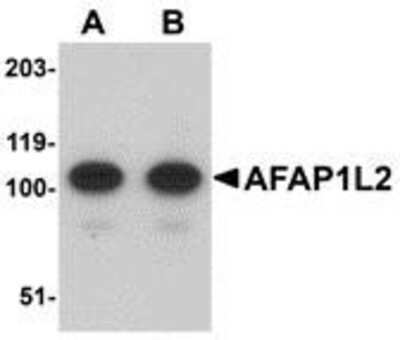
| Specificity | Detects endogenous human AFAP in Western blots. |
| Source | N/A |
| Isotype | IgG |
| Clonality | Polyclonal |
| Host | Goat |
| Gene | AFAP1 |
| Purity Statement | Antigen Affinity-purified |
| Innovator's Reward | Test in a species/application not listed above to receive a full credit towards a future purchase. |
| Storage | Use a manual defrost freezer and avoid repeated freeze-thaw cycles.
|
| Buffer | Lyophilized from a 0.2 μm filtered solution in PBS with Trehalose. *Small pack size (SP) is supplied either lyophilized or as a 0.2 µm filtered solution in PBS. |
| Preservative | No Preservative |
| Concentration | LYOPH |
| Reconstitution Instructions | Reconstitute at 0.2 mg/mL in sterile PBS. |
AFAP (actin filament associated protein; also known as AFAP-110) is an adaptor protein that regulates actin filament integrity. It is both multimodular and multimeric, and is known to simultaneously bind actin and cytosolic kinases. As a homomultimer, AFAP binds and separates actin filaments, preventing actin cross-linking. Upon binding to kinases, AFAP is destabilized, promoting actin polymerization. Human AFAP is 730 amino acids (aa) in length, and contains SH3 and SH2 binding motifs (aa 69‑74 and aa 91‑96), two pleckstrin homology domains (aa 153‑248 and aa 347‑450) and a Leu-zipper/actin binding region (aa 511‑637). Over aa 450‑730, human AFAP is 86% identical to mouse and rat AFAP.


![In-situ Hybridization Fibroblast Activation Protein alpha/FAP Antibody [Unconjugated]](https://images.novusbio.com/images/antibody/af3715_human-fap-affinity-purified-polyclonal-ab-in-situ-hybridization-2352024182645..jpg)
![Western Blot Fibroblast Activation Protein alpha/FAP Antibody [Unconjugated]](https://images.novusbio.com/images/antibody/Fibroblast_Activation_Protein_alpha_AF3715_Western_Blot_11934.jpg)
![Simple Western Fibroblast Activation Protein alpha/FAP Antibody [Unconjugated]](https://images.novusbio.com/images/antibody/af3715_human-fap-affinity-purified-polyclonal-ab-simple-western-110202114645.jpg)






Secondary Antibodies |
Isotype Controls |
The concentration calculator allows you to quickly calculate the volume, mass or concentration of your vial. Simply enter your mass, volume, or concentration values for your reagent and the calculator will determine the rest.


![Western Blot Src [p Tyr419] Antibody [Unconjugated]](https://images.novusbio.com/images/antibody/Src_AF2685_Western_Blot_5209.jpg)
![Immunohistochemistry Src [p Tyr419] Antibody [Unconjugated]](https://images.novusbio.com/images/af2685_human-phospho-src-y419-affinity-purified-polyclonal-ab-412024124022.jpg)
![Immunohistochemistry Src [p Tyr419] Antibody [Unconjugated]](https://images.novusbio.com/images/antibody/Src_AF2685_Immunohistochemistry_9943.jpg)


![Immunocytochemistry/ Immunofluorescence c-jun [p Ser63] Antibody (SY0297)](https://images.novusbio.com/images/c-jun-p-Ser63-Antibody-SY0297-Immunocytochemistry-Immunofluorescence-NBP2-67471-img0006.jpg)
![Western Blot c-jun [p Ser63] Antibody (SY0297)](https://images.novusbio.com/images/c-jun-p-Ser63-Antibody-SY0297-Western-Blot-NBP2-67471-img0008.jpg)
![Western Blot c-jun [p Ser63] Antibody (SY0297)](https://images.novusbio.com/images/c-jun-p-Ser63-Antibody-SY0297-Western-Blot-NBP2-67471-img0009.jpg)