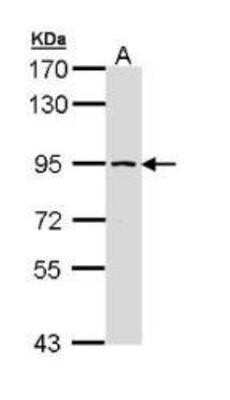
HMGB2 Knockout 293T Cell Lysate Summary
Preparation Method |
Knockout achieved by using CRISPR/Cas9,26 bp deletion in exon 2 |
| Gene |
HMGB2 |
Applications/Dilutions
| Dilutions |
|
| Application Notes |
You will receive 1 vial (100ug) of knockout cell lysate and 1 vial (100ug) of Parental cell lysate. Lysate can be diluted with 1X SDS sample buffer and will be stable at -20 degrees C for 12 months. Minimize freeze-thaw cycles. |
Packaging, Storage & Formulations
| Storage |
Store at -20C short term. Aliquot and store at -80C long term. Avoid freeze-thaw cycles. |
| Buffer |
0.1 mg cell homogenate lyophilized in RIPA buffer made with double-knockout cell lines. |
| Concentration |
LYOPH |
| Reconstitution Instructions |
To use as WB negative control, spin down briefly and resuspend in 100 uL 1xSDS sample buffer (2% SDS, 60 mM Tris-HCl pH 6.8, 10% Glycerol, 0.02% Bromophenol blue, 60 mM beta-mercaptoethanol). Boil the lysate for 3 - 5 minutes before loading it onto gel. |
Lysate Details for Array
| Type |
Knockout 293T Cell |
| Life Stage |
Embryonic |
| Tissue |
Kidney |
Notes
Powered by EDIGENE.
Validation of antibody specificity is critical and verification of antibody performance against knockout samples is one way to guarantee that an antibody recognizes a specific target. Novus' KO cell lysate can be used as a negative control for western blots and to confirm the specificity of antibodies.
Alternate Names for HMGB2 Knockout 293T Cell Lysate
Background
This gene encodes a member of the non-histone chromosomal high mobility group protein family. The proteins of this family are chromatin-associated and ubiquitously distributed in the nucleus of higher eukaryotic cells. In vitro studies have demonstrated that this protein is able to efficiently bend DNA and form DNA circles. These studies suggest a role in facilitating cooperative interactions between cis-acting proteins by promoting DNA flexibility. This protein was also reported to be involved in the final ligation step in DNA end-joining processes of DNA double-strand breaks repair and V(D)J recombination. [provided by RefSeq, Jul 2008]
Limitations
This product is for research use only and is not approved for use in humans or in clinical diagnosis. Lysates are
guaranteed for 6 months from date of receipt.
Customers Who Viewed This Item Also Viewed...
Species: Bv, Ca, Hu, Mu, Rb, Rt, Sh
Applications: ELISA, Flow-IC, Flow, ICC/IF, IHC, IHC-P, KD, Simple Western, WB
Species: Hu, Mu, Rt
Applications: IHC-P, IP, Simple Western, WB
Species: Hu, Mu
Applications: WB
Species: Hu, Rt
Applications: ICC/IF, IHC, IHC-P, WB
Species: Mu
Applications: ChIP, WB
Species: Hu
Applications: ICC/IF, IHC, IHC-P, WB
Species: Hu, Mu, Rt
Applications: ICC/IF, IHC, IHC-P, WB
Species: Hu
Applications: ELISA, ICC, WB
Species: Hu
Applications: ELISA, AP, PA, WB
Species: Hu
Applications: WB
Species: Hu
Applications: CyTOF-ready, ELISA, Flow, ICC/IF, IHC, IHC-P, WB
Species: Hu
Applications: IHC, IHC-P, IP, WB
Species: Hu, Mu
Applications: ELISA, IHC, WB
Species: Hu, Mu, Rt
Applications: Flow, ICC/IF, IHC, IHC-P, WB
Species: Hu
Applications: IHC, IHC-P, IP, WB (-)
Species: Bv, Ca, Hu, Po, Pm, Rb
Applications: WB
Species: Hu, Mu, Rt
Applications: ICC/IF, IHC, IHC-P, WB
Species: Hu, Pm
Applications: ICC/IF, IHC, IHC-P
Publications for HMGB2 Lysate (NBP2-65701) (0)
There are no publications for HMGB2 Lysate (NBP2-65701).
By submitting your publication information earn gift cards and discounts for future purchases.
Reviews for HMGB2 Lysate (NBP2-65701) (0)
There are no reviews for HMGB2 Lysate (NBP2-65701).
By submitting a review you will receive an Amazon e-Gift Card or Novus Product Discount.
- Review with no image -- $10/€7/£6/$10 CAD/¥70 Yuan/¥1110 Yen
- Review with an image -- $25/€18/£15/$25 CAD/¥150 Yuan/¥2500 Yen
Product General Protocols
Find general support by application which include: protocols, troubleshooting, illustrated assays, videos and webinars.
Video Protocols
FAQs for HMGB2 Lysate (NBP2-65701) (0)
Additional HMGB2 Products
Research Areas for HMGB2 Lysate (NBP2-65701)
Find related products by research area.
|
Blogs on HMGB2