| Reactivity | HuSpecies Glossary |
| Applications | WB |
| Clone | 198401 |
| Clonality | Monoclonal |
| Host | Mouse |
| Conjugate | Unconjugated |
| Immunogen | Mouse myeloma cell line NS0-derived recombinant human Hepassocin/FGL1 Met1-Ile312 Accession # BAB70690 |
| Specificity | Detects human Hepassocin/FGL1 in direct ELISAs and Western blots. In direct ELISAs, weak cross-reactivity with rat Hepassocin/FGL1 is observed. In Western blots, 100% cross-reactivity with rat Hepassocin/FGL1 is observed. |
| Source | N/A |
| Isotype | IgG1 |
| Clonality | Monoclonal |
| Host | Mouse |
| Gene | FGL1 |
| Purity Statement | Protein A or G purified from hybridoma culture supernatant |
| Innovator's Reward | Test in a species/application not listed above to receive a full credit towards a future purchase. |
| Dilutions |
|
|
| Publications |
|
| Storage | Use a manual defrost freezer and avoid repeated freeze-thaw cycles.
|
| Buffer | Lyophilized from a 0.2 μm filtered solution in PBS with Trehalose. *Small pack size (SP) is supplied either lyophilized or as a 0.2 µm filtered solution in PBS. |
| Preservative | No Preservative |
| Reconstitution Instructions | Reconstitute at 0.5 mg/mL in sterile PBS. |




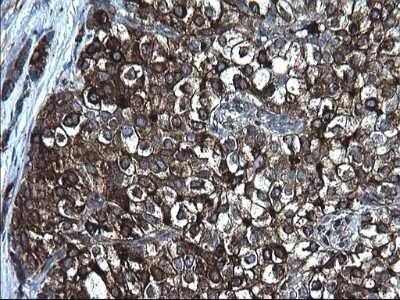
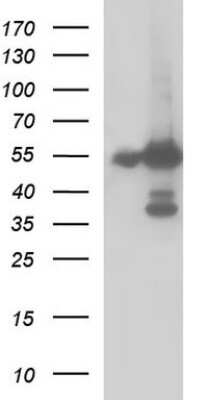


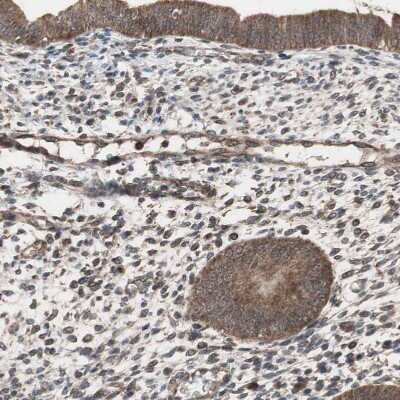
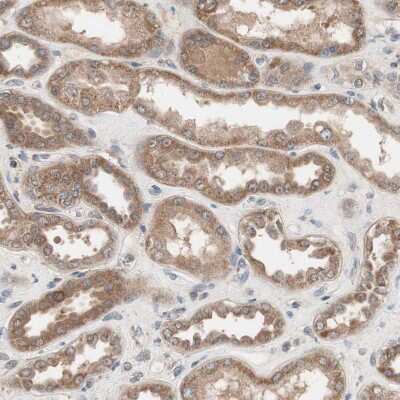
| Publication using MAB1614 | Applications | Species |
|---|---|---|
| Liu Z, Ukomadu C Fibrinogen-like protein 1, a hepatocyte derived protein is an acute phase reactant. Biochem. Biophys. Res. Commun., 2007-11-26;365(4):729-34. 2007-11-26 [PMID: 18039467] (Western Blot, Human) | Western Blot | Human |
Secondary Antibodies |
Isotype Controls |
The concentration calculator allows you to quickly calculate the volume, mass or concentration of your vial. Simply enter your mass, volume, or concentration values for your reagent and the calculator will determine the rest.


![N/A IL-6 [HRP]](https://images.novusbio.com/images/elisa/DATA_IL6_M6000_ELISA_936.jpg)
![N/A IL-6 [HRP]](https://images.novusbio.com/images/elisa/IL-6_M6000_ELISA_415.jpg)
![N/A IL-6 [HRP]](https://images.novusbio.com/images/m6000b_mouse-il-6-quantikine-elisa-kit-1752025024034.jpg)




![Western Blot p38 gamma/SAPK3 Antibody [Unconjugated]](https://images.novusbio.com/images/antibody/p38_gamma_AF1347_Western_Blot_12768.jpg)
![Simple Western p38 gamma/SAPK3 Antibody [Unconjugated]](https://images.novusbio.com/images/antibody/p38_gamma_AF1347_Simple_Western_16621.jpg)
![Western Blot p38 gamma/SAPK3 Antibody [Unconjugated]](https://images.novusbio.com/images/af1347_human-mouse-rat-p38-gamma-affinity-purified-pab-44202415425098.jpg)


![Western Blot EMMPRIN/CD147 Antibody [Unconjugated]](https://images.novusbio.com/images/antibody/EMMPRIN_AF972_Western_Blot_16707.jpg)
![Immunohistochemistry EMMPRIN/CD147 Antibody [Unconjugated]](https://images.novusbio.com/images/antibody/EMMPRIN_AF972_Immunohistochemistry_7348.jpg)
![Immunohistochemistry EMMPRIN/CD147 Antibody [Unconjugated]](https://images.novusbio.com/images/antibody/EMMPRIN_AF972_Immunohistochemistry_17212.jpg)