| Reactivity | HuSpecies Glossary |
| Applications | WB |
| Clonality | Polyclonal |
| Host | Goat |
| Conjugate | Alexa Fluor 488 |
| Immunogen | E. coli-derived recombinant human DRAK1 Ala115-Glu313 Accession # Q9UEE5 |
| Specificity | Detects human DRAK1 in direct ELISAs and Western blots. In direct ELISAs, approximately 10% cross‑reactivity with recombinant human DRAK2 is observed. |
| Isotype | IgG |
| Clonality | Polyclonal |
| Host | Goat |
| Purity Statement | Antigen Affinity-purified |
| Innovator's Reward | Test in a species/application not listed above to receive a full credit towards a future purchase. |
| Storage | Protect from light. Do not freeze. 12 months from date of receipt, 2 to 8 °C as supplied |
| Buffer | Supplied 0.2 mg/mL in a saline solution containing BSA and Sodium Azide. |
DRAK1 (DAP kinase-related apoptosis-inducing protein kinase 1; also STK17A) is a 55 kDa member of the DAP kinase subfamily, CAMK Ser/Thr protein kinase family of enzymes. It is expressed in osteoclasts, resides in the nucleus and initiates apoptosis. Human DRAK1 is 414 amino acids (aa) in length. It contains an N‑terminal polyPro segment (aa 33‑37) followed by a Ser/Thr kinase domain (aa 64‑321) with a catalytic loop (aa 184‑193). Apoptosis apparently requires an intact kinase domain. No rodent DRAK1 has been reported. Over aa 115‑313, human DRAK1 is 95% aa identical to canine DRAK1, and 65% aa identical to human DRAK2.
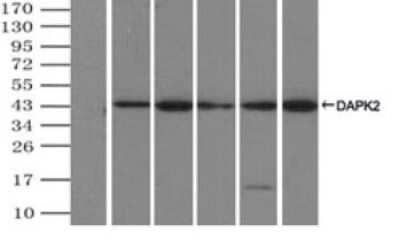
![Western Blot DRAK2 Antibody (685228) [Unconjugated]](https://images.novusbio.com/images/antibody/DRAK2_MAB6640_Western_Blot_10597.jpg)









Secondary Antibodies |
Isotype Controls |
The concentration calculator allows you to quickly calculate the volume, mass or concentration of your vial. Simply enter your mass, volume, or concentration values for your reagent and the calculator will determine the rest.
| Uniprot |
|




![SDS-Page TRANCE/TNFSF11/RANK L [Unconjugated]](https://images.novusbio.com/images/protein/TRANCE_462-TEC_442.jpg)
![Bioactivity TRANCE/TNFSF11/RANK L [Unconjugated]](https://images.novusbio.com/images/protein/TRANCE_462-TEC_556.jpg)