HAF017). A specific band was detected for Prolactin at approximately 23 kDa (as indicated). This experiment was conducted under reducing conditions and using
Immunoblot Buffer Group 1." class="big_lightbox">
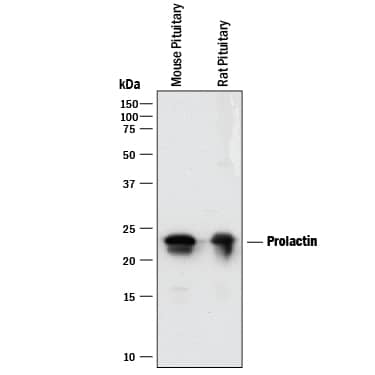
HAF017). A specific band was detected for Prolactin at approximately 23 kDa (as indicated). This experiment was conducted under reducing conditions and using
Immunoblot Buffer Group 1." alt="Western blot shows lysates of mouse pituitary tissue and rat pituitary tissue. PVDF membrane was probed with 0.25 µg/mL of Goat Anti-Mouse/Rat Prolactin Antigen Affinity-purified Polyclonal Antibody (Catalog # AF1445) followed by HRP-conjugated Anti-Goat IgG Secondary Antibody (
HAF017). A specific band was detected for Prolactin at approximately 23 kDa (as indicated). This experiment was conducted under reducing conditions and using
Immunoblot Buffer Group 1." class="big_thumb" />
1445-PL) stimulates proliferation in the Nb2-11 rat lymphoma cell line in a dose-dependent manner (orange line). Proliferation elicited by Recombinant Mouse Prolactin (10 ng/mL) is neutralized (green line) by increasing concentrations of Goat Anti-Mouse/Rat Prolactin Antigen Affinity-purified Polyclonal Antibody (Catalog # AF1445). The ND
50 is typically 0.25-1.0 µg/mL." class="big_lightbox">

1445-PL) stimulates proliferation in the Nb2-11 rat lymphoma cell line in a dose-dependent manner (orange line). Proliferation elicited by Recombinant Mouse Prolactin (10 ng/mL) is neutralized (green line) by increasing concentrations of Goat Anti-Mouse/Rat Prolactin Antigen Affinity-purified Polyclonal Antibody (Catalog # AF1445). The ND
50 is typically 0.25-1.0 µg/mL." class="big_thumb" />

1445-PL) was serially diluted and captured by Goat Anti-Mouse/Rat Prolactin Antigen Affinity-purified Polyclonal Antibody (Catalog # AF1445) coated on a Clear Polystyrene Microplate (Catalog #
DY990). Goat Anti-Mouse/Rat Prolactin Antigen Affinity-purified Polyclonal Antibody (Catalog #
AF1445) was biotinylated and incubated with the protein captured on the plate. Detection of the standard curve was achieved by incubating Streptavidin-HRP (Catalog #
DY998)" class="big_lightbox">

1445-PL) was serially diluted and captured by Goat Anti-Mouse/Rat Prolactin Antigen Affinity-purified Polyclonal Antibody (Catalog # AF1445) coated on a Clear Polystyrene Microplate (Catalog #
DY990). Goat Anti-Mouse/Rat Prolactin Antigen Affinity-purified Polyclonal Antibody (Catalog #
AF1445) was biotinylated and incubated with the protein captured on the plate. Detection of the standard curve was achieved by incubating Streptavidin-HRP (Catalog #
DY998)" class="big_thumb" />
1445-PL) was serially diluted and captured by Goat Anti-Mouse/Rat Prolactin Antigen Affinity-purified Polyclonal Antibody (Catalog #
AF1445) coated on a Clear Polystyrene Microplate (Catalog #
DY990). Goat Anti-Mouse/Rat Prolactin Antigen Affinity-purified Polyclonal Antibody (Catalog # AF1445) was biotinylated and incubated with the protein captured on the plate. Detection of the standard curve was achieved by incubating Streptavidin-HRP (Catalog #
DY998)" class="big_lightbox">

1445-PL) was serially diluted and captured by Goat Anti-Mouse/Rat Prolactin Antigen Affinity-purified Polyclonal Antibody (Catalog #
AF1445) coated on a Clear Polystyrene Microplate (Catalog #
DY990). Goat Anti-Mouse/Rat Prolactin Antigen Affinity-purified Polyclonal Antibody (Catalog # AF1445) was biotinylated and incubated with the protein captured on the plate. Detection of the standard curve was achieved by incubating Streptavidin-HRP (Catalog #
DY998)" class="big_thumb" />
 HAF017). A specific band was detected for Prolactin at approximately 23 kDa (as indicated). This experiment was conducted under reducing conditions and using Immunoblot Buffer Group 1." alt="Western blot shows lysates of mouse pituitary tissue and rat pituitary tissue. PVDF membrane was probed with 0.25 µg/mL of Goat Anti-Mouse/Rat Prolactin Antigen Affinity-purified Polyclonal Antibody (Catalog # AF1445) followed by HRP-conjugated Anti-Goat IgG Secondary Antibody (HAF017). A specific band was detected for Prolactin at approximately 23 kDa (as indicated). This experiment was conducted under reducing conditions and using Immunoblot Buffer Group 1." class="big_thumb" />
 HAF017). A specific band was detected for Prolactin at approximately 23 kDa (as indicated). This experiment was conducted under reducing conditions and using Immunoblot Buffer Group 1." alt="Western blot shows lysates of human pituitary tissue. PVDF membrane was probed with 0.25 µg/mL of Goat Anti-Human Prolactin Antigen Affinity-purified Polyclonal Antibody (Catalog # AF682) followed by HRP-conjugated Anti-Goat IgG Secondary Antibody (Catalog # HAF017). A specific band was detected for Prolactin at approximately 23 kDa (as indicated). This experiment was conducted under reducing conditions and using Immunoblot Buffer Group 1." class="big_thumb" />
 HAF018). A specific band was detected for Prolactin at approximately 24 kDa (as indicated). This experiment was conducted under reducing conditions and using Western Blot Buffer Group 1." alt="Western Blot shows lysates of human pituitary tissue. PVDF membrane was probed with 0.5 µg/ml of Mouse Anti-Human Prolactin Monoclonal Antibody (Catalog # MAB11590) followed by HRP-conjugated Anti-Mouse IgG Secondary Antibody (Catalog # HAF018). A specific band was detected for Prolactin at approximately 24 kDa (as indicated). This experiment was conducted under reducing conditions and using Western Blot Buffer Group 1." class="big_thumb" />
 HAF005). A specific band was detected for Prolactin at approximately 23 kDa (as indicated). This experiment was conducted under reducing conditions and using Immunoblot Buffer Group 1." alt="Western blot shows lysates of mouse pituitary tissue and rat pituitary tissue. PVDF membrane was probed with 1 µg/mL of Rat Anti-Mouse/Rat Prolactin Monoclonal Antibody (Catalog # MAB1445) followed by HRP-conjugated Anti-Rat IgG Secondary Antibody (Catalog # HAF005). A specific band was detected for Prolactin at approximately 23 kDa (as indicated). This experiment was conducted under reducing conditions and using Immunoblot Buffer Group 1." class="big_thumb" />


 1445-PL) stimulates proliferation in the Nb2-11 rat lymphoma cell line in a dose-dependent manner (orange line). Proliferation elicited by Recombinant Mouse Prolactin (10 ng/mL) is neutralized (green line) by increasing concentrations of Goat Anti-Mouse/Rat Prolactin Antigen Affinity-purified Polyclonal Antibody (Catalog # AF1445). The ND50 is typically 0.25-1.0 µg/mL." class="big_thumb" />
 VC004) and counterstained with hematoxylin (blue). Specific staining was localized to cytoplasm in lactotroph cells. View our protocol for


 1445-PL) was serially diluted and captured by Goat Anti-Mouse/Rat Prolactin Antigen Affinity-purified Polyclonal Antibody (Catalog # AF1445) coated on a Clear Polystyrene Microplate (Catalog #
  1445-PL) was serially diluted and captured by Goat Anti-Mouse/Rat Prolactin Antigen Affinity-purified Polyclonal Antibody (Catalog #
  CTS008) and counterstained with hematoxylin (blue). Specific staining was localized to cytoplasm of sperm cells. View our protocol for
 682-PL) induced proliferation in the Nb2 11 rat lymphoma cell line. The Neutralization Dose (ND50) for this effect is typically 0.0200-0.200 µg/mL." class="big_thumb" />
 682-PL) was serially diluted and captured by Goat Anti-Human Prolactin Antigen Affinity-purified Polyclonal Antibody (Catalog # AF682) coated on a Clear Polystyrene Microplate (Catalog #
  682-PL) was serially diluted and captured by Goat Anti-Human Prolactin Antigen Affinity-purified Polyclonal Antibody (Catalog #
 ![Western Blot: Prolactin Antibody (6B1) [NBP2-02142] - HEK293T cells were transfected with the pCMV6-ENTRY control (Left lane) or pCMV6-ENTRY Prolactin (Right lane) cDNA for 48 hrs and lysed. Equivalent amounts of cell lysates (5 ug per lane) were separated by SDS-PAGE and immunoblotted with anti-Prolactin.](http://images.novusbio.com/fullsize/Prolactin-Antibody-6B1-Western-Blot-NBP2-02142-img0003.jpg "Western Blot: Prolactin Antibody (6B1) [NBP2-02142] - HEK293T cells were transfected with the pCMV6-ENTRY control (Left lane) or pCMV6-ENTRY Prolactin (Right lane) cDNA for 48 hrs and lysed. Equivalent amounts of cell lysates (5 ug per lane) were separated by SDS-PAGE and immunoblotted with anti-Prolactin.")
![Immunocytochemistry/Immunofluorescence: Prolactin Antibody (6B1) [NBP2-02142] Staining of COS7 cells transiently transfected by pCMV6-ENTRY Prolactin.](http://images.novusbio.com/fullsize/Prolactin-Antibody-6B1-Immunocytochemistry-Immunofluorescence-NBP2-02142-img0008.jpg)
![Immunohistochemistry-Paraffin: Prolactin Antibody (6B1) [NBP2-02142] - Staining of paraffin-embedded Human Ovary tissue using anti-Prolactin mouse monoclonal antibody.](http://images.novusbio.com/fullsize/Prolactin-Antibody-6B1-Immunohistochemistry-Paraffin-NBP2-02142-img0007.jpg)
![Flow Cytometry: Prolactin Antibody (6B1) [NBP2-02142] - Analysis of Jurkat cells, using anti-Prolactin antibody, (Red), compared to a nonspecific negative control antibody (Blue).](http://images.novusbio.com/fullsize/Prolactin-Antibody-6B1-Flow-Cytometry-NBP2-02142-img0002.jpg)
![Immunocytochemistry/Immunofluorescence: Prolactin Antibody (6B1) [NBP2-02142] - Immunofluorescent staining of HepG2 cells using anti-Prolactin mouse monoclonal antibody.](http://images.novusbio.com/fullsize/Prolactin-Antibody-6B1-Immunocytochemistry-Immunofluorescence-NBP2-02142-img0004.jpg)
![Immunohistochemistry-Paraffin: Prolactin Antibody (6B1) [NBP2-02142] - Staining of paraffin-embedded Human breast tissue using anti-Prolactin mouse monoclonal antibody.](http://images.novusbio.com/fullsize/Prolactin-Antibody-6B1-Immunohistochemistry-Paraffin-NBP2-02142-img0005.jpg)
![Immunohistochemistry-Paraffin: Prolactin Antibody (6B1) [NBP2-02142] - Staining of paraffin-embedded Human endometrium tissue using anti-Prolactin mouse monoclonal antibody.](http://images.novusbio.com/fullsize/Prolactin-Antibody-6B1-Immunohistochemistry-Paraffin-NBP2-02142-img0006.jpg)
![Flow Cytometry: Prolactin Antibody (6B1) [NBP2-02142] - Analysis of Hela cells, using anti-Prolactin antibody, (Red), compared to a nonspecific negative control antibody (Blue).](http://images.novusbio.com/fullsize/Prolactin-Antibody-6B1-Flow-Cytometry-NBP2-02142-img0001.jpg)
![N/A Prolactin [Biotin]](http://images.novusbio.com/fullsize/elisa/DATA_Prolactin_DY682_ELISA_2178.jpg "N/A Prolactin [Biotin]")
![SDS-Page: Mouse Prolactin Protein [NBP2-35120]](http://images.novusbio.com/fullsize/Mouse-Prolactin-Protein-SDS-Page-NBP2-35120-img0001.jpg "SDS-Page: Mouse Prolactin Protein [NBP2-35120]")
![N/A Prolactin [HRP]](http://images.novusbio.com/fullsize/elisa/DATA_Prolactin_DPRL00_ELISA_796.jpg "N/A Prolactin [HRP]")
![N/A Prolactin [HRP]](http://images.novusbio.com/fullsize/elisa/Prolactin_DPRL00_ELISA_446.jpg)
![N/A Prolactin [Biotin]](http://images.novusbio.com/fullsize/elisa/DATA_Prolactin_DY1445_ELISA_1648.jpg "N/A Prolactin [Biotin]")

 VC001). Before incubation with the primary antibody, tissue was subjected to heat-induced epitope retrieval using VisUCyte Antigen Retrieval Reagent-Basic (Catalog #


