| Preparation Method |
Knockout achieved by using CRISPR/Cas9,-1 bp deletion in exon2 and 1 bp insertion in exon2 |
| Gene | UBN1 |
| Dilutions |
|
| Application Notes | You will receive 1 vial (100ug) of knockout cell lysate and 1 vial (100ug) of Parental cell lysate. Lysate can be diluted with 1X SDS sample buffer and will be stable at -20 degrees C for 12 months. Minimize freeze-thaw cycles. |
| Storage | Store at -20C short term. Aliquot and store at -80C long term. Avoid freeze-thaw cycles. |
| Buffer | 0.1 mg cell homogenate lyophilized in RIPA buffer made with double-knockout cell lines. |
| Concentration | LYOPH |
| Reconstitution Instructions | To use as WB negative control, spin down briefly and resuspend in 100 uL 1xSDS sample buffer (2% SDS, 60 mM Tris-HCl pH 6.8, 10% Glycerol, 0.02% Bromophenol blue, 60 mM beta-mercaptoethanol). Boil the lysate for 3 - 5 minutes before loading it onto gel. |


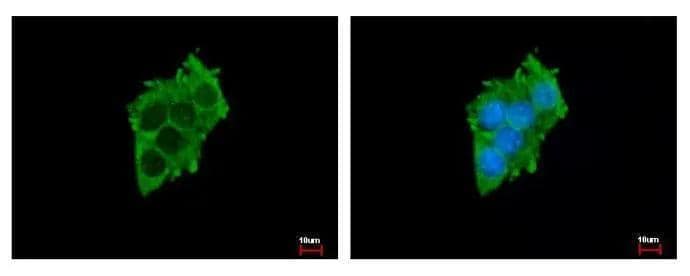
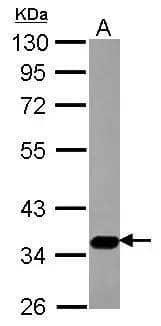
![ELISA Granzyme A Antibody [Unconjugated]](https://images.novusbio.com/images/antibody/Granzyme_A_AF2905_ELISA_22249.jpg)
![Western Blot Granzyme A Antibody [Unconjugated]](https://images.novusbio.com/images/antibody/Granzyme_A_AF2905_Western_Blot_23415.jpg)
![Immunocytochemistry Granzyme A Antibody [Unconjugated]](https://images.novusbio.com/images/antibody/Granzyme_A_AF2905_Immunocytochemistry_10939.jpg)



The concentration calculator allows you to quickly calculate the volume, mass or concentration of your vial. Simply enter your mass, volume, or concentration values for your reagent and the calculator will determine the rest.
| Gene Symbol | UBN1 |


![SDS-Page TNF-alpha [Unconjugated]](https://images.novusbio.com/images/protein/TNF-alpha_210-TA_256.jpg)
![Bioactivity TNF-alpha [Unconjugated]](https://images.novusbio.com/images/protein/TNFalpha_210TA_1658.jpg)
![SEC-MALS TNF-alpha [Unconjugated]](https://images.novusbio.com/images/210-ta_recombinant-human-tnf-alpha-protein-sec-mals-35202312244..jpg)


![N/A IL-6 [HRP]](https://images.novusbio.com/images/elisa/DATA_IL6_M6000_ELISA_936.jpg)
![N/A IL-6 [HRP]](https://images.novusbio.com/images/elisa/IL-6_M6000_ELISA_415.jpg)
![N/A IL-6 [HRP]](https://images.novusbio.com/images/m6000b_mouse-il-6-quantikine-elisa-kit-1752025024034.jpg)
![Immunohistochemistry Complement Factor H Antibody [Unconjugated]](https://images.novusbio.com/images/antibody/Complement_Factor_H_AF4779_Immunohistochemistry_7182.jpg)


![Western Blot Growth Hormone Antibody [Unconjugated]](https://images.novusbio.com/images/antibody/Growth_Hormone_AF1067_Western_Blot_20961.jpg)