| Reactivity | Hu, Mu, RtSpecies Glossary |
| Applications | WB, IHC, ICC/IF |
| Clone | 763651 |
| Clonality | Monoclonal |
| Host | Mouse |
| Conjugate | Alexa Fluor 405 |
| Immunogen | E. coli-derived recombinant human Thioredoxin‑1 Val2-Val105 Accession # P10599 |
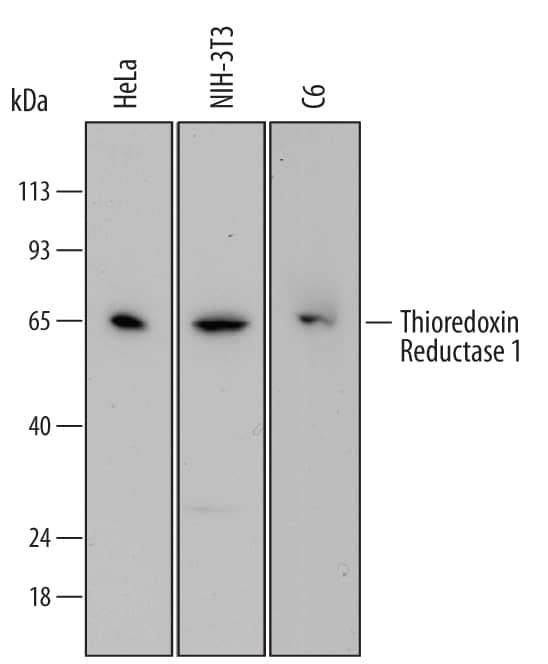
| Specificity | Detects human Thioredoxin‑1 in direct ELISAs. Detects human, mouse, and rat Thioredoxin‑1 in Western blots. |
| Source | N/A |
| Isotype | IgG2b |
| Clonality | Monoclonal |
| Host | Mouse |
| Purity Statement | Protein A or G purified from hybridoma culture supernatant |
| Innovator's Reward | Test in a species/application not listed above to receive a full credit towards a future purchase. |
| Storage | Protect from light. Do not freeze. 12 months from date of receipt, 2 to 8 °C as supplied |
| Buffer | Supplied 0.2 mg/mL in a saline solution containing BSA and Sodium Azide. |
Thioredoxins (Trxs) are a group of small ubiquitous proteins in all living cells that are key regulators of cellular redox balance (1, 2). The mammalian Trx family has three members. The Trx-1, which is a secreted and cellular protein, the mitochondria-specific Trx-2, and the Trx-like cytosolic protein p32TrxL (3‑5). The active site of mammalian Trxs contains two cysteines in the conserved sequence -Y-C-G-P-C-K-. In Trx-1 the conserved cysteine residues are in positions 32 and 35, respectively. Trxs exist either in a reduced or in an oxidized state when the two cysteines at the active site form an intramolecular disulfide bridge. NADPH and the flavoprotein thioredoxin reductase can convert the oxidized Trx into the reduced Trx. Trx-1 is the only extracellular occurring thioredoxin, and is secreted by lymphocytes, hepatocytes, fibroblasts, and several tumor cells. Plasma concentrations of Trx-1 are up to 6 nM (6). In cells, Trx-1 is localized predominantly in the cytoplasm. Small amounts have been detected in the nucleus and in association with the outside surface of the cells. Expression of Trx-1 is increased under various stress conditions such as hypoxia, elevated hydrogen peroxide concentrations, photochemical oxidative stress, and viral and bacterial infections. Biological functions of Trx-1 include growth factor activity, antioxidant properties, a cofactor that provides reducing equivalents, and transcriptional regulation (1, 2). The synovial tissue of rheumatoid arthritis patients produces increased levels of Trx-1 under oxidative stress conditions, and a correlation exists between the plasma levels of Trx-1 and the severity of the disease, making Trx-1 a biomarker for this pathological condition (7, 8).


Secondary Antibodies |
Isotype Controls |
The concentration calculator allows you to quickly calculate the volume, mass or concentration of your vial. Simply enter your mass, volume, or concentration values for your reagent and the calculator will determine the rest.
| Uniprot |
|


![SDS-Page Neuregulin-1 beta 1/NRG1 beta 1 [Unconjugated]](https://images.novusbio.com/images/protein/Neuregulin-1_beta_1_396-HB_222.jpg)
![SEC-MALS Neuregulin-1 beta 1/NRG1 beta 1 [Unconjugated]](https://images.novusbio.com/images/396-hb_recombinant-human-nrg1-beta-1-hrg1-beta-1-egf-domain-protein-sec-mals-51220258550.jpg)
![Bioactivity Neuregulin-1 beta 1/NRG1 beta 1 [Unconjugated]](https://images.novusbio.com/images/protein/Neuregulin-1_beta_1_396-HB_626.jpg)

![SDS-Page TNF-alpha [Unconjugated]](https://images.novusbio.com/images/protein/TNF-alpha_210-TA_256.jpg)
![Bioactivity TNF-alpha [Unconjugated]](https://images.novusbio.com/images/protein/TNFalpha_210TA_1658.jpg)
![SEC-MALS TNF-alpha [Unconjugated]](https://images.novusbio.com/images/210-ta_recombinant-human-tnf-alpha-protein-sec-mals-35202312244..jpg)
![Immunocytochemistry Catalase Antibody [Unconjugated]](https://images.novusbio.com/images/antibody/Catalase_AF3398_Immunocytochemistry__Immunofluorescence_19451.jpg)
![Simple Western Catalase Antibody [Unconjugated]](https://images.novusbio.com/images/antibody/Catalase_AF3398_Simple_Western_16990.jpg)
![Immunohistochemistry Insulin Antibody (182410) [Unconjugated]](https://images.novusbio.com/images/antibody/mab1417_human-bovine-mouse-insulin-mab-clone-182410-immunohistochemistry-308202115145.jpg)
![Immunocytochemistry Insulin Antibody (182410) [Unconjugated]](https://images.novusbio.com/images/antibody/Insulin_MAB1417_Immunocytochemistry_9376.jpg)
![Immunocytochemistry/ Immunofluorescence c-jun [p Ser63] Antibody (SY0297)](https://images.novusbio.com/images/c-jun-p-Ser63-Antibody-SY0297-Immunocytochemistry-Immunofluorescence-NBP2-67471-img0006.jpg)
![Western Blot c-jun [p Ser63] Antibody (SY0297)](https://images.novusbio.com/images/c-jun-p-Ser63-Antibody-SY0297-Western-Blot-NBP2-67471-img0008.jpg)
![Western Blot c-jun [p Ser63] Antibody (SY0297)](https://images.novusbio.com/images/c-jun-p-Ser63-Antibody-SY0297-Western-Blot-NBP2-67471-img0009.jpg)

![Bioactivity IL-2 [Unconjugated]](https://images.novusbio.com/images/202-il_recombinant-human-il-2-protein-bioactivity-174202314946.jpg)