Recombinant Human OTOA GST (N-Term) Protein Summary
| Description |
A recombinant protein with a N-terminal GST tag corresponding to the amino acid sequence 27-124 of Human OTOA Source: Wheat Germ (in vitro) Amino Acid Sequence: NSRQDLHPLLQNMAEEIIDGSYLNALLDLIQFQSSHVWTDDLSHRVLAYLNSRNVAFTIPSLQAAVENHLEQRLHQPQKLLEDLRKTDAQQFRTAMKC |
Preparation Method |
in vitro wheat germ expression system |
| Details of Functionality |
This protein was produced in an in vitro wheat germ expression system that should preserve correct conformational folding that is necessary for biological function. While it is possible that this protein could display some level of activity, the functionality of this protein has not been explicitly measured or validated. |
| Source |
Wheat germ |
| Protein/Peptide Type |
Partial Recombinant Protein |
| Gene |
OTOA |
| Purity |
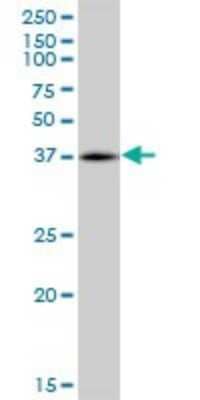
>80% by SDS-PAGE and Coomassie blue staining |
Applications/Dilutions
| Dilutions |
- ELISA
- Immunoaffinity Purification
- Protein Array
- Western Blot
|
| Theoretical MW |
36.52 kDa. Disclaimer note: The observed molecular weight of the protein may vary from the listed predicted molecular weight due to post translational modifications, post translation cleavages, relative charges, and other experimental factors. |
Packaging, Storage & Formulations
| Storage |
Store at -80C. Avoid freeze-thaw cycles. |
| Buffer |
50 mM Tris-HCI, 10 mM reduced Glutathione, pH 8.0 in the elution buffer. |
| Preservative |
No Preservative |
| Purity |
>80% by SDS-PAGE and Coomassie blue staining |
Notes
This product is produced by and distributed for Abnova, a company based in Taiwan.
Alternate Names for Recombinant Human OTOA GST (N-Term) Protein
Background
The protein encoded by the OTOA gene is specifically expressed in the inner ear, and is located at the interface betweenthe apical surface of the inner ear sensory epithelia and their overlying acellular gels. It is prposed that thisprotein is involved in the attachment of the inner ear acellular gels to the apical surface of the underlyingnonsensory cells. Mutations in this gene are associated with autosomal recessive deafness type 22 (DFNB22).Alternatively spliced transcript variants encoding different isoforms have been found for this gene. (provided byRefSeq)
Limitations
This product is for research use only and is not approved for use in humans or in clinical diagnosis. Peptides and proteins are
guaranteed for 3 months from date of receipt.
Customers Who Viewed This Item Also Viewed...
Species: Hu
Applications: CyTOF-ready, ELISA, Flow, KO
Species: Hu
Applications: IHC, IHC-P
Species: Hu
Applications: IHC, IHC-Fr, IHC-P
Species: Hu
Applications: PEP-ELISA, WB
Species: Hu
Applications: WB
Species: Hu, Mu, Rt
Applications: ICC/IF, WB
Species: Hu, Mu
Applications: IHC, IHC-P, WB
Species: Hu
Applications: ELISA, S-ELISA, WB
Species: Hu
Applications: IHC, IHC-P
Species: Hu, Mu, Rt
Applications: Flow, ICC/IF, WB
Species: Mu, Pm, Rt
Applications: IHC, IHC-Fr, IHC-P, WB
Species: Hu
Applications: BA
Species: Hu, Mu, Rt
Applications: IHC, IHC-P, WB
Species: Hu
Applications: IHC, IHC-P, WB
Species: Ca, Ha, Hu, Mu, Po, Pm, Rt
Applications: B/N, Flow, ICC/IF, IHC, IHC-P, IP, WB
Species: Hu
Applications: ICC/IF, IHC, IHC-P, WB
Species: Hu, Po, Rt
Applications: ELISA, ICC/IF, IHC, IHC-P, WB
Species: Hu, Mu, Rt
Applications: IHC, IHC-P, WB
Species: Hu
Applications: Bind
Species: Hu
Applications: WB, ELISA, MA, AP
Publications for OTOA Partial Recombinant Protein (H00146183-Q01) (0)
There are no publications for OTOA Partial Recombinant Protein (H00146183-Q01).
By submitting your publication information earn gift cards and discounts for future purchases.
Reviews for OTOA Partial Recombinant Protein (H00146183-Q01) (0)
There are no reviews for OTOA Partial Recombinant Protein (H00146183-Q01).
By submitting a review you will receive an Amazon e-Gift Card or Novus Product Discount.
- Review with no image -- $10/€7/£6/$10 CAD/¥70 Yuan/¥1110 Yen
- Review with an image -- $25/€18/£15/$25 CAD/¥150 Yuan/¥2500 Yen
Product General Protocols
Find general support by application which include: protocols, troubleshooting, illustrated assays, videos and webinars.
Video Protocols
FAQs for OTOA Partial Recombinant Protein (H00146183-Q01) (0)
Additional OTOA Products
Blogs on OTOA