| Reactivity | HuSpecies Glossary |
| Applications | WB, IP |
| Clonality | Polyclonal |
| Host | Sheep |
| Conjugate | Alexa Fluor 350 |
| Immunogen | Chinese hamster ovary cell line CHO-derived recombinant human NAALADase-like 1/NAALADL1 Ala32-Leu740 Accession # NP_005459 |
| Specificity | Detects human NAALADase-like 1/NAALADL1 in direct ELISAs and Western blots. In direct ELISAs, less than 1% cross‑reactivity with recombinant human (rh) NAALADase I, recombinant mouse NAALADase II, and rhNAALADase II is observed. |
| Isotype | IgG |
| Clonality | Polyclonal |
| Host | Sheep |
| Purity Statement | Antigen Affinity-purified |
| Innovator's Reward | Test in a species/application not listed above to receive a full credit towards a future purchase. |
| Storage | Protect from light. Do not freeze. 12 months from date of receipt, 2 to 8 °C as supplied |
| Buffer | Supplied 0.2 mg/mL in a saline solution containing BSA and Sodium Azide. |
NAALADase-like1, also known as NAALADL1, (N-acetylated alpha -linked acidic dipeptidase like 1; also Ileal dipeptidylpeptidase) is a 100-115 kDa member of the peptidase M28 family of enzymes. It is found in the brush border of Ileal epithelium and demonstrates serine protease activity. Human NAALADL1 is a type II transmembrane glycoprotein that is 740 amino acids (aa) in length. It contains an extended extracellular domain (aa 29‑740) that shows a protease-associated region (aa 109‑335) with key catalytic residues at Ser617, Asp657 and His687. Multiple splice variants exist. Two show deletions of aa 161‑201 and 296‑330, respectively, while a third shows a 51 aa insertion after Pro359. Three show 18 to 42 aa substitutions after Pro502, with premature truncations after Ile522, Thr543 and Leu579. A final isoform shows a 17 aa substitution for aa 619‑740. Over aa 32‑740, human NAALADL1 shares 81% aa identity with mouse NAALADL1.
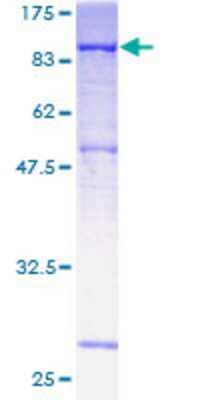


![Immunohistochemistry NAALADase-2/NAALAD2 Antibody (756030) [Unconjugated]](https://images.novusbio.com/images/antibody/12521.jpg)
![Western Blot NAALADase-2/NAALAD2 Antibody (756030) [Unconjugated]](https://images.novusbio.com/images/antibody/12514.jpg)
Secondary Antibodies |
Isotype Controls |
The concentration calculator allows you to quickly calculate the volume, mass or concentration of your vial. Simply enter your mass, volume, or concentration values for your reagent and the calculator will determine the rest.


![Immunocytochemistry/ Immunofluorescence DPPIV/CD26 Antibody [Unconjugated]](https://images.novusbio.com/images/af1180_human-dppiv-cd26-affinity-purified-polyclonal-ab-44202415425025.jpg)
![Western Blot DPPIV/CD26 Antibody [Unconjugated]](https://images.novusbio.com/images/af1180_human-dppiv-cd26-affinity-purified-polyclonal-ab-812025555283.jpg)
![Immunohistochemistry DPPIV/CD26 Antibody [Unconjugated]](https://images.novusbio.com/images/antibody/DPPIV_AF1180_Immunohistochemistry_17209.jpg)
![Bioactivity IL-4 [Unconjugated]](https://images.novusbio.com/images/protein/6507-ilcf_recombinant-human-il-4-cho-expressed-protein-cf-bioactivity-272020133214.jpg)
![Western Blot CISH/CIS-1 Antibody [Unconjugated]](https://images.novusbio.com/images/antibody/CIS-1_AF3194_Western_Blot_5249.jpg)
![Simple Western CISH/CIS-1 Antibody [Unconjugated]](https://images.novusbio.com/images/antibody/af3194_human-cis-1-affinity-purified-polyclonal-ab-simple-western-1342022124434.jpg)
![Immunocytochemistry CISH/CIS-1 Antibody [Unconjugated]](https://images.novusbio.com/images/antibody/af3194_human-cis-1-affinity-purified-polyclonal-ab-immunocytochemistry-309202194844.jpg)



![SEC-MALS IL-15 [Unconjugated]](https://images.novusbio.com/images/247-ilb_recombinant-human-il-15-protein-sec-mals-2922024964..jpg)