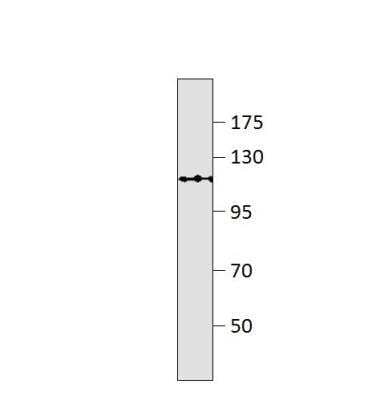
HAF016). A specific band was detected for GPR111 at approximately 72 kDa (as indicated). This experiment was conducted under reducing conditions and using Immunoblot Buffer Group 1." title="Western blot shows lysates of human lung tissue. PVDF Membrane was probed with 1 µg/mL of Human GPR111 Antigen Affinity-purified Polyclonal Antibody (Catalog # AF6494) followed by HRP-conjugated Anti-Sheep IgG Secondary Antibody (Catalog # HAF016). A specific band was detected for GPR111 at approximately 72 kDa (as indicated). This experiment was conducted under reducing conditions and using Immunoblot Buffer Group 1." />
| Reactivity | HuSpecies Glossary |
| Applications | WB |
| Clonality | Polyclonal |
| Host | Sheep |
| Conjugate | Unconjugated |
| Concentration | LYOPH |
| Immunogen | Chinese hamster ovary cell line CHO-derived recombinant human GPR111 Cys19-Ser375 Accession # NP_722581 |
| Specificity | Detects human GPR111 in direct ELISAs and Western blots. In direct ELISAs, less than 2% cross-reactivity with recombinant human (rh) GPR30, rhGPR56, rhGPR114, rhGPR115, rhGPR124, and rhGPR125 is observed. |
| Source | N/A |
| Isotype | IgG |
| Clonality | Polyclonal |
| Host | Sheep |
| Gene | ADGRF2P |
| Purity Statement | Antigen Affinity-purified |
| Innovator's Reward | Test in a species/application not listed above to receive a full credit towards a future purchase. |
| Storage | Use a manual defrost freezer and avoid repeated freeze-thaw cycles.
|
| Buffer | Lyophilized from a 0.2 μm filtered solution in PBS with Trehalose. *Small pack size (SP) is supplied either lyophilized or as a 0.2 µm filtered solution in PBS. |
| Preservative | No Preservative |
| Concentration | LYOPH |
| Reconstitution Instructions | Sterile PBS to a final concentration of 0.2 mg/mL. |
GPR111 (G-protein coupled receptor 111; also PRG20) is a 71 kDa (predicted), seven transmembrane (TM) member of the GPR-2 family, LN-7TM subfamily of molecules. It is reportedly expressed in lung, mammary gland and diencephalon. Human GPR111 is 642 amino acids (aa) in length. It contains an extended N-terminal extracellular region with a mucin like stalk (aa 1-383), followed by a series of seven TM domains and a short C-terminal cytoplasmic tail. The N-terminus possesses a GPS (GPCR proteolytic site) (aa 324-368) that likely generates a soluble cleavage product. GPR111 is considered an adhesion-type GPCR, and as such, is expected to form dimers, if not oligomers . There is one potential splice variant for GPR111. It shows a 92 aa substitution for aa 1-24 coupled to a 19 aa substitution for aa 622-642. Over aa 19-375, human GPR111 shares 68% aa identity with mouse GPR111.
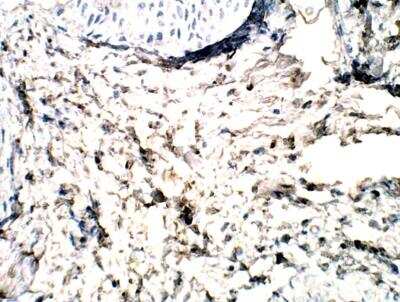
![Flow Cytometry EMR3 Antibody (908235) [Unconjugated]](https://images.novusbio.com/images/antibody/EMR3_MAB8496_Flow_Cytometry_16807.jpg)
![Immunohistochemistry EMR3 Antibody (908235) [Unconjugated]](https://images.novusbio.com/images/mab8496_human-emr3-mab-clone-908235-immunohistochemistry-2852021145344.jpg)

Secondary Antibodies |
Isotype Controls |
The concentration calculator allows you to quickly calculate the volume, mass or concentration of your vial. Simply enter your mass, volume, or concentration values for your reagent and the calculator will determine the rest.


![Flow Cytometry GPR56 Antibody [Unconjugated]](https://images.novusbio.com/images/antibody/GPR56_AF4634_Flow_Cytometry_12104.jpg)
![Immunocytochemistry/ Immunofluorescence GPR56 Antibody [Unconjugated]](https://images.novusbio.com/images/af4634_human-gpr56-affinity-purified-polyclonal-ab-immunocytochemistry-immunofluorescence-12122025931542.jpg)
![Immunocytochemistry/ Immunofluorescence GPR56 Antibody [Unconjugated]](https://images.novusbio.com/images/af4634_human-gpr56-affinity-purified-polyclonal-ab-immunocytochemistry-immunofluorescence-12122025932153.jpg)
![Immunohistochemistry GPR64 Antibody [Unconjugated]](https://images.novusbio.com/images/antibody/GPR64_AF7977_Immunohistochemistry_13077.jpg)