HAF016). A specific band was detected for TEX19 at approximately 18 kDa (as indicated). This experiment was conducted under reducing conditions and using Immunoblot Buffer Group 8." title="Western blot shows lysates of NTera-2 human testicular embryonic carcinoma cell line. PVDF Membrane was probed with 0.5 µg/mL of Human TEX19 Antigen Affinity-purified Polyclonal Antibody (Catalog # AF6319) followed by HRP-conjugated Anti-Sheep IgG Secondary Antibody (Catalog # HAF016). A specific band was detected for TEX19 at approximately 18 kDa (as indicated). This experiment was conducted under reducing conditions and using Immunoblot Buffer Group 8." />
| Reactivity | HuSpecies Glossary |
| Applications | WB, ICC/IF |
| Clonality | Polyclonal |
| Host | Sheep |
| Conjugate | Unconjugated |
| Concentration | LYOPH |
| Immunogen | E. coli-derived recombinant human TEX19 Met1-Ser164 Accession # Q8NA77 |
| Specificity | Detects human TEX19 in direct ELISAs and Western blots. In direct ELISAs, less than 2% cross-reactivity with recombinant human TEX11 is observed. |
| Source | N/A |
| Isotype | IgG |
| Clonality | Polyclonal |
| Host | Sheep |
| Gene | TEX19 |
| Purity Statement | Antigen Affinity-purified |
| Innovator's Reward | Test in a species/application not listed above to receive a full credit towards a future purchase. |
| Dilutions |
|
|
| Publications |
|
| Storage | Use a manual defrost freezer and avoid repeated freeze-thaw cycles.
|
| Buffer | Lyophilized from a 0.2 μm filtered solution in PBS with Trehalose. *Small pack size (SP) is supplied either lyophilized or as a 0.2 µm filtered solution in PBS. |
| Preservative | No Preservative |
| Concentration | LYOPH |
| Reconstitution Instructions | Sterile PBS to a final concentration of 0.2 mg/mL. |
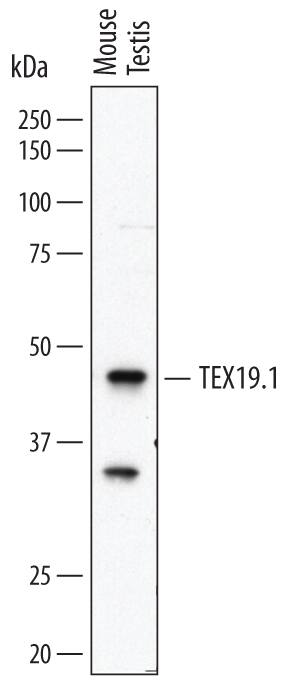
TEX19 (testis expressed sequence 19) is an 18 kDa (predicted) protein with restricted cell expression. It is expressed in spermatogonia as well as pluripotent stem cells. TEX19 has been found in both nucleus and cytoplasm. Functionally, TEX19 is proposed to guard against inappropriately activated endogenous retroviruses during meiosis, and thus prevent deleterious mutations. Human TEX19 is 164 amino acids (aa) in length. There is no identifiable structural module within the protein. There are, however, two sequences that are conserved in TEX19 from multiple species. These are an MCP domain between aa 1-58, and a VPTEL domain that spans aa 120-157. Over aa 1-164, human TEX19 shares only 53% aa identity with a highly divergent and substantially larger 42 kDa mouse TEX19.1 protein.


Secondary Antibodies |
Isotype Controls |
The concentration calculator allows you to quickly calculate the volume, mass or concentration of your vial. Simply enter your mass, volume, or concentration values for your reagent and the calculator will determine the rest.


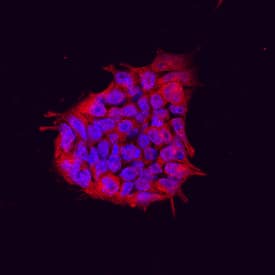
 NL010) and counterstained with DAPI (blue, lower panel). Specific staining was localized to nuclei and cytoplasm. View our protocol for


![Immunocytochemistry Oct-3/4 Antibody [Unconjugated]](https://images.novusbio.com/images/antibody/Oct-3_4_AF1759_Immunocytochemistry_7093.jpg)
![Simple Western Oct-3/4 Antibody [Unconjugated]](https://images.novusbio.com/images/antibody/Oct3_4_AF1759_Simple_Western_20183.jpg)
![Western Blot Oct-3/4 Antibody [Unconjugated]](https://images.novusbio.com/images/antibody/Oct3_4_AF1759_Western_Blot_20390.jpg)