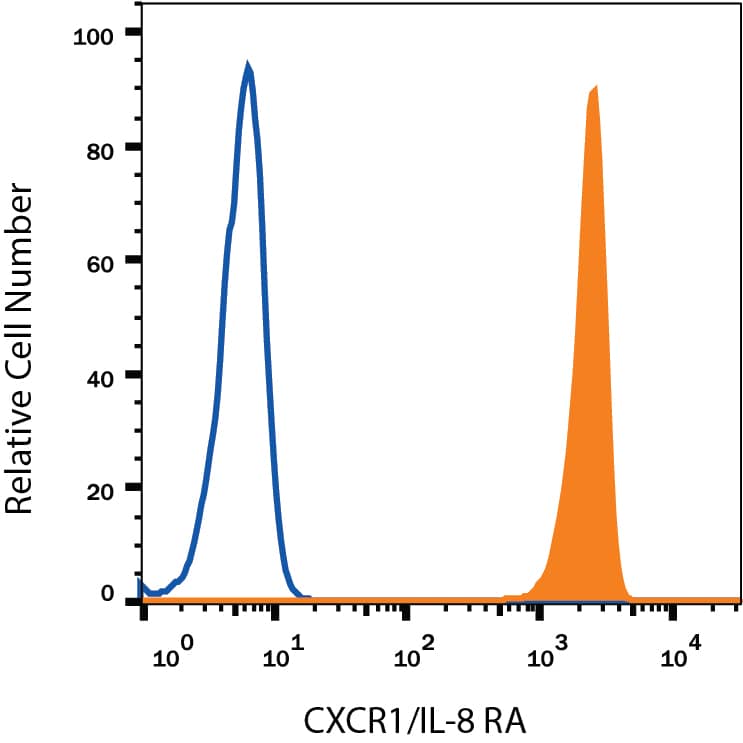
F0101B). Quadrant markers were set based on Mouse IgG2B isotype control antibody staining (Catalog # MAB0041). View our protocol for Staining Membrane-associated Proteins." title="HEK293 human embryonic kidney cell line transfected with (A) Human LPAR4 or (B) irrelevant protein, and EGFP, was stained with Mouse Anti-Human LPAR4 Monoclonal Antibody (Catalog # MAB10217) followed by Allophycocyanin-conjugated Anti-Mouse IgG Secondary Antibody (Catalog # F0101B). Quadrant markers were set based on Mouse IgG2B isotype control antibody staining (Catalog # MAB0041). View our protocol for Staining Membrane-associated Proteins." />
| Reactivity | HuSpecies Glossary |
| Applications | Flow, CyTOF-ready |
| Clone | 561203 |
| Clonality | Monoclonal |
| Host | Mouse |
| Conjugate | Unconjugated |
| Immunogen | Human embryonic kidney cell line HEK293-derived transfected with human LPAR4/LPA4 Accession # Q99677 |
| Specificity | Detects human LPAR4/LPA4 in direct ELISAs. |
| Source | N/A |
| Isotype | IgG2a |
| Clonality | Monoclonal |
| Host | Mouse |
| Purity Statement | Protein A or G purified from hybridoma culture supernatant |
| Innovator's Reward | Test in a species/application not listed above to receive a full credit towards a future purchase. |
| Storage | Use a manual defrost freezer and avoid repeated freeze-thaw cycles.
|
| Buffer | Lyophilized from a 0.2 μm filtered solution in PBS with Trehalose. *Small pack size (SP) is supplied either lyophilized or as a 0.2 µm filtered solution in PBS. |
| Reconstitution Instructions | Reconstitute at 0.5 mg/mL in sterile PBS. |
Lysophosphatidic acid receptor 4, also known as LPA4, P2Y purinoceptor 9 (P2RY9) or GPR23, is a protein that in humans is encoded by the LPAR4 gene. LPA4 is a G protein-coupled receptor (GPCR) that binds the lipid signaling molecule lysophosphatidic acid (LPA) and mediates diverse cellular activities. Most LPA receptors share similarities with members of the S1P1/Edg family. GPA4, originally named P2Y9/GPR23, has been described as a fourth LPA receptor, LPA4, that together with LPA5 and LPA6 form a subfamily of LPA receptors structurally distant from the Edg family.






![LPAR4/LPA4 Antibody (561203) [Unconjugated]](/sites/all/modules/enterprise-tech/et_datasheets/images/novus_guarantee.png "LPAR4/LPA4 Antibody (561203) [Unconjugated]")
Secondary Antibodies |
Isotype Controls |
The concentration calculator allows you to quickly calculate the volume, mass or concentration of your vial. Simply enter your mass, volume, or concentration values for your reagent and the calculator will determine the rest.
| Uniprot |
|






![Flow Cytometry S1P1/EDG-1 Antibody (713412) [Unconjugated]](https://images.novusbio.com/images/antibody/S1P1_MAB7089_Flow_Cytometry_11459.jpg)
![Immunohistochemistry S1P1/EDG-1 Antibody (713412) [Unconjugated]](https://images.novusbio.com/images/antibody/S1P1_MAB7089_Immunohistochemistry_12044.jpg)
![Flow Cytometry S1P1/EDG-1 Antibody (713412) [Unconjugated]](https://images.novusbio.com/images/antibody/S1P1_MAB7089_Flow_Cytometry_22010.jpg)