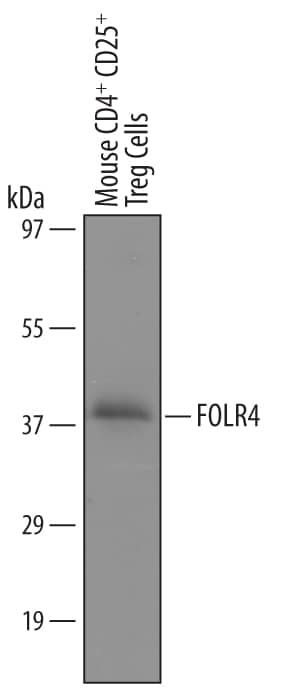
 HAF016). A specific band was detected for FOLR4 at approximately 37 kDa (as indicated). This experiment was conducted under reducing conditions and using Immunoblot Buffer Group 8." title="Western blot shows lysates of mouse CD+CD25+regulatory T cells. PVDF Membrane was probed with 1 µg/mL of Sheep Anti-Mouse FOLR4 Antigen Affinity-purified Polyclonal Antibody (Catalog # AF6124) followed by HRP-conjugated Anti-Sheep IgG Secondary Antibody (Catalog # HAF016). A specific band was detected for FOLR4 at approximately 37 kDa (as indicated). This experiment was conducted under reducing conditions and using Immunoblot Buffer Group 8." />
| Reactivity | MuSpecies Glossary |
| Applications | WB, Flow, CyTOF-ready |
| Clonality | Polyclonal |
| Host | Sheep |
| Conjugate | Unconjugated |
| Concentration | LYOPH |
| Immunogen | E. coli-derived recombinant mouse FOLR4 Gly20-Ser100 Accession # Q9EQF4 |
| Specificity | Detects mouse FOLR4 in direct ELISAs and Western blots. In direct ELISAs, less than 1% cross-reactivity with recombinant human (rh) FOLR1, rhFOLR2, rhFOLR3, and rhFOLR4 is observed. |
| Source | N/A |
| Isotype | IgG |
| Clonality | Polyclonal |
| Host | Sheep |
| Gene | IZUMO1R |
| Purity Statement | Antigen Affinity-purified |
| Innovator's Reward | Test in a species/application not listed above to receive a full credit towards a future purchase. |
| Storage | Use a manual defrost freezer and avoid repeated freeze-thaw cycles.
|
| Buffer | Lyophilized from a 0.2 μm filtered solution in PBS with Trehalose. *Small pack size (SP) is supplied either lyophilized or as a 0.2 µm filtered solution in PBS. |
| Preservative | No Preservative |
| Concentration | LYOPH |
| Reconstitution Instructions | Reconstitute at 0.2 mg/mL in sterile PBS. |
FOLR4 (folate receptor 4; also FR4, FR‑δ and FOLBP‑3) is a 35 kDa glycoprotein member of the folate receptor family. It is found on mouse Treg cells, particularly those classified as natural and CD4+ CD25- T cells that produce low amounts of IFN-gamma . Its function is unclear. Although folate family receptors can internalize folate, they are generally not the principal conduits for folate uptake. Mouse FOLR4 preproprecursor is 244 amino acids (aa) in length. It contains a 19 aa signal sequence plus a 225 aa proform. While there are no definitive structural motifs, there is presumably a C-terminal propeptide that gives rise to a GPI-linkage. There are three potential isoforms. One is 37 kDa in size and shows a 36 aa insertion after Glu155. Two others show a deletion of aa 47‑109, and a 17 aa substitution for aa 157‑244. Over aa 20‑100, mouse FOLR4 shares 84% and 70% aa identity with rat and human FOLR4, respectively.
![Flow Cytometry FOLR1 Antibody (548908) [Unconjugated]](https://images.novusbio.com/images/antibody/FOLR1_MAB5646_Flow_Cytometry_10781.jpg)
![Immunocytochemistry FOLR1 Antibody (548908) [Unconjugated]](https://images.novusbio.com/images/antibody/FOLR1_MAB5646_Immunocytochemistry_6624.jpg)
![Flow Cytometry FOLR1 Antibody (548908) [Unconjugated]](https://images.novusbio.com/images/antibody/mab5646_human-folr1-mab-clone-548908-flow-cytometry-2312024152128..jpg)

Secondary Antibodies |
Isotype Controls |
The concentration calculator allows you to quickly calculate the volume, mass or concentration of your vial. Simply enter your mass, volume, or concentration values for your reagent and the calculator will determine the rest.


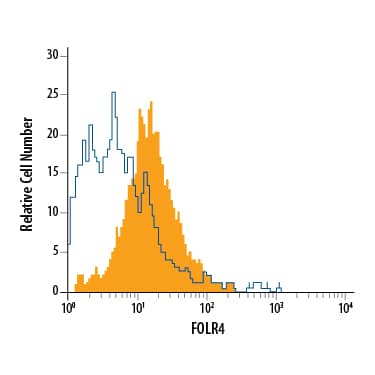 402-ML), and Human TGF-beta 1 (Catalog #