Spike RBD Antibody (1049349) [Unconjugated] Summary
| Immunogen |
Human embryonic kidney cell HEK293-derived SARS-CoV-2 Spike RBD
Val16-Pro681
Accession # YP_009724390.1 |
| Specificity |
Detects SARS-CoV-2 Spike RBD in direct ELISAs. |
| Source |
N/A |
| Isotype |
IgG2b |
| Clonality |
Monoclonal |
| Host |
Mouse |
| Purity Statement |
Protein A or G purified from hybridoma culture supernatant |
| Innovator's Reward |
Test in a species/application not listed above to receive a full credit towards a future purchase. |
Applications/Dilutions
| Dilutions |
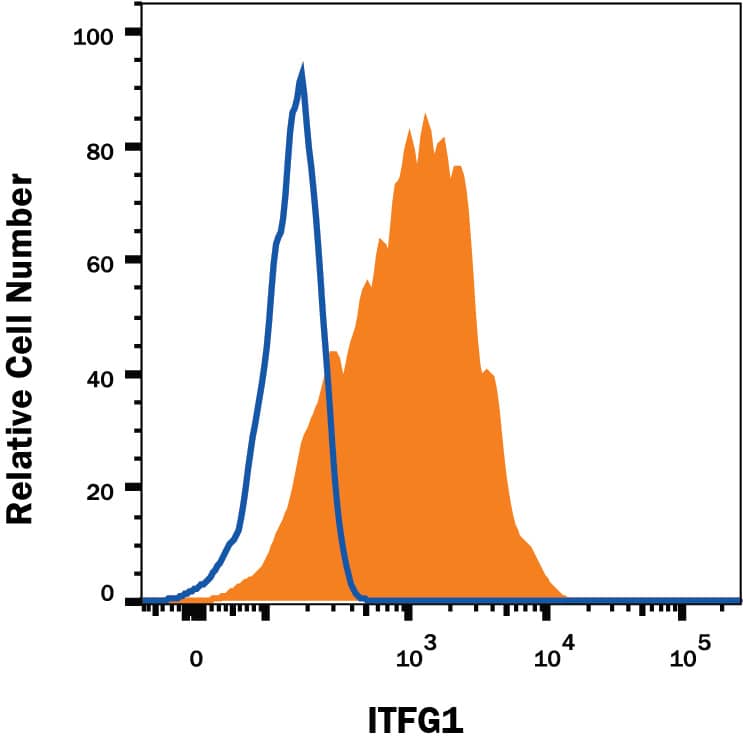
- Flow Cytometry 0.25 ug/10^6 cells
- Immunocytochemistry 8-25 ug/mL
|
Packaging, Storage & Formulations
| Storage |
Use a manual defrost freezer and avoid repeated freeze-thaw cycles. - 12 months from date of receipt, -20 to -70 °C as supplied.
- 1 month, 2 to 8 °C under sterile conditions after reconstitution.
- 6 months, -20 to -70 °C under sterile conditions after reconstitution.
|
| Buffer |
Lyophilized from a 0.2 μm filtered solution in PBS with Trehalose. *Small pack size (SP) is supplied either lyophilized or as a 0.2 µm filtered solution in PBS. |
| Reconstitution Instructions |
Reconstitute at 0.5 mg/mL in sterile PBS. |
Notes
This product is produced by and ships from R&D Systems, Inc., a Bio-Techne brand.
Alternate Names for Spike RBD Antibody (1049349) [Unconjugated]
Background
SARS-CoV-2, which causes the global pandemic
coronavirus disease 2019 (Covid-19), belongs to a family of viruses known as
coronaviruses that are commonly comprised of four structural proteins: Spike
protein(S), Envelope protein (E), Membrane protein (M), and Nucleocapsid
protein (N) (1). SARS-CoV-2 Spike Protein (S Protein) is a homotrimeric
glycoprotein that mediates membrane fusion and viral entry. As with most
coronaviruses, proteolytic cleavage of the SARS-CoV-2 S protein into two
distinct peptides, S1 and S2 subunits, is required for activation. The S1
subunit is focused on attachment of the protein to the host receptor while the
S2 subunit is involved with cell fusion (2-5). A SARS-CoV-2 variant (named CAL.20C)
carrying the S1 subunit amino acid (aa) change W152C, L452R, and D614G emerged
in Southern Califonia (6,7). Based on structural biology studies, the receptor
binding domain (RBD), located in the C-terminal region of S1, can be oriented
either in the up/standing or down/lying state (8). The standing state is
associated with higher pathogenicity and both SARS-CoV-1 and MERS can access
this state due to the flexibility in their respective RBDs. A similar two-state
structure and flexibility is found in the SARS-CoV-2 RBD (9). Based on amino
acid (aa) sequence homology, the SARS-CoV-2 S1 subunit has 65% identity with
SARS-CoV-1 S1 subunit, but only 22% homology with the MERS S1 subunit. The low
aa sequence homology is consistent with the finding that SARS and MERS bind
different cellular receptors (10). The S Protein of the SARS-CoV-2 virus, like
the SARS-CoV-1 counterpart, binds Angiotensin-Converting Enzyme 2 (ACE-2), but
with much higher affinity and faster binding kinetics (11). Before binding to
the ACE-2 receptor, structural analysis of the S1 trimer shows that only one of
the three RBD domains in the trimeric structure is in the "up"
conformation. This is an unstable and transient state that passes between
trimeric subunits but is nevertheless an exposed state to be targeted for
neutralizing antibody therapy (12). Polyclonal antibodies to the RBD of the
SARS-CoV-2 S1 subunit have been shown to inhibit interaction with the ACE-2
receptor, confirming S1 subunit especially the RBD as an attractive target for
vaccinations or antiviral therapy (13). There is also promising work showing
that the RBD may be used to detect presence of neutralizing antibodies present
in a patient's bloodstream, consistent with developed immunity after exposure
to the SARS-CoV-2 virus (14). Lastly, it has been demonstrated the S Protein
can invade host cells through the CD147/EMMPRIN receptor and mediate membrane
fusion (15, 16).
- Wu, F. et al. (2020) Nature 579:265.
- Tortorici, M.A. and D. Veesler (2019) Adv. Virus Res. 105:93.
- Bosch, B.J. et al. (2003) J. Virol. 77:8801.
- Belouzard, S. et al. (2009) Proc. Natl. Acad. Sci. 106:5871.
- Millet, J.K. and G.R. Whittaker (2015) Virus Res. 202:120.
- Zhang, W. et al. (2021) JAMA https://doi.org/10.1001/jama.2021.1612.
- Zhang, W. et al. (2021). MedRxiv https://doi.org/10.1101/2021.01.18.21249786.
- Yuan, Y. et al. (2017) Nat. Commun. 8:15092.
- Walls, A.C. et al. (2010) Cell 180:281.
- Jiang, S. et al. (2020) Trends. Immunol. https://doi.org/10.1016/j.it.2020.03.007.
- Ortega, J. T. et al. (2020) EXCLI J. 19:410.
- Wrapp, D. et al. (2020) Science 367:1260.
- Tai, W. et al. (2020) Cell. Mol. Immunol. https://doi.org/10.1016/j.it.2020.03.007.
- Okba, N.M.A. et al. (2020). Emerg. Infect. Dis. https://doi.org/10.3201/eid2607.200841.
- Wang, X. et al. (2020) https://doi.org/10.1038/s41423-020-0424-9.
- Wang, K. et al. (2020) ioRxiv https://www.biorxiv.org/content/10.1101/2020.03.14.988345v1.
Limitations
This product is for research use only and is not approved for use in humans or in clinical diagnosis. Primary Antibodies are
guaranteed for 1 year from date of receipt.
Publications for Spike RBD Antibody (MAB11055) (0)
There are no publications for Spike RBD Antibody (MAB11055).
By submitting your publication information earn gift cards and discounts for future purchases.
Reviews for Spike RBD Antibody (MAB11055) (0)
There are no reviews for Spike RBD Antibody (MAB11055).
By submitting a review you will receive an Amazon e-Gift Card or Novus Product Discount.
- Review with no image -- $10/€7/£6/$10 CAD/¥70 Yuan/¥1110 Yen
- Review with an image -- $25/€18/£15/$25 CAD/¥150 Yuan/¥2500 Yen
Product General Protocols
Find general support by application which include: protocols, troubleshooting, illustrated assays, videos and webinars.
FAQs for Spike RBD Antibody (MAB11055) (0)