![Immunocytochemistry/Immunofluorescence: Tat-Beclin 1 D11 Autophagy Inducing Peptide [NBP2-49888] - HeLa GFP-LC3B cells were treated with Tat-D11, Tat-L11, Tat-Beclin 1 or Tat-L11S for 1.5 hours. Thereafter, the cells were stained using NeuroTrace Red or DAPI and analyzed employing fluorescent microscopy. Note the higher number of autophagosomes/GFP-LC3B+ puncta in the images of Tat-D11 and Tat-L11 treated cells when compared to Tat-Beclin 1 and Tat-L11S treated cells.](http://images.novusbio.com/fullsize/Tat-Beclin-1-D11-Autophagy-Inducing-Peptide-Immunocytochemistry-Immunofluorescence-NBP2-49888-img0002.jpg "Immunocytochemistry/Immunofluorescence: Tat-Beclin 1 D11 Autophagy Inducing Peptide [NBP2-49888] - HeLa GFP-LC3B cells were treated with Tat-D11, Tat-L11, Tat-Beclin 1 or Tat-L11S for 1.5 hours. Thereafter, the cells were stained using NeuroTrace Red or DAPI and analyzed employing fluorescent microscopy. Note the higher number of autophagosomes/GFP-LC3B+ puncta in the images of Tat-D11 and Tat-L11 treated cells when compared to Tat-Beclin 1 and Tat-L11S treated cells.")
| Reactivity | All-NASpecies Glossary |
| Applications | Func |
| Concentration | LYOPH |
| Description | Tat-D11 [NBP2-49888]: peptides comprising 11 amino acids derived from Beclin 1 linked to the HIV Tat protein with a diglycine linker. These peptides are in the retero-inverso D-configuration. The amino acid sequence of Tat-Beclin 1 D11 is RRRQRRKKRGYGGDHWIHFTANWV (Bio-Techne's exclusive patent license: US Patent 8,802,633). |
| Background | Cell-penetrating autophagy inducing peptides engineered in 2013 were demonstrated to induce autophagy through interaction with the autophagy suppressor GAPR-1/GLIPR2 (Nature, 2013; PMID 23364696). These Tat-Beclin 1 peptides were comprised of AA 267-284 of the autophagy inducer Beclin 1 (18 amino acids), a diglycine linker, and 11 amino acids of the HIV Tat protein transduction domain. Tat-B...eclin 1 peptides were re-engineered to remove 7 AA from the beclin 1 domain. These shorter peptides, Tat-D11 [NBP2-49888] and Tat-L11 [NBP2-49886], demonstrate enhanced autophagy inducing function over the original Tat-Beclin 1 peptides and the scrambled control peptide Tat-L11S [NBP2-49887]. Tat-D11 and Tat-L11 are potent autophagy inducers which function both in vitro and in vivo to specifically induce autophagy. Tat-D11 and Tat-L11 peptides are comprised of 11 amino acids of the autophagy-inducing region of beclin 1 fused to the HIV Tat protein. Both Tat-D11 and Tat-L11 peptides function by binding the negative regulator of autophagy GAPR-1/GLIPR2. Upon peptide binding, beclin 1 bound to GARP-1 is released, resulting in beclin 1 mediated autophagosome formation and autophagy induction. Data indicate Tat-D11 is more potent than both Tat-L11 and Tat-Beclin 1 in vivo. In addition, initial data derived from HeLa cells also suggests Tat-D11 is more potent than Tat-L11 in vitro. However, ongoing experiments indicate Tat-L11 may be more potent than Tat-D11 in select cell lines. Show More |
| Protein/Peptide Type | Autophagy Inducing Peptide |
| Dilutions |
|
|
| Theoretical MW | 3.08 kDa. Disclaimer note: The observed molecular weight of the protein may vary from the listed predicted molecular weight due to post translational modifications, post translation cleavages, relative charges, and other experimental factors. |
|
| Reviewed Applications |
|
|
| Publications |
|
| Storage | Store at -20C in powder form. Store at -80C once reconstituted. |
| Buffer | This product is supplied lyophilized. Purity is >= to 97% (HPLC) |
| Concentration | LYOPH |
| Reconstitution Instructions | Reconstitute with DMSO or water to desired concetration. Note:- D11 should NOT be reconstituted at a concentration greater than 5 mM. |
| Images | Ratings | Applications | Species | Date | Details | ||||||||
|---|---|---|---|---|---|---|---|---|---|---|---|---|---|
Enlarge |
reviewed by:
Verified Customer |
In vivo treatment + immunoblot analysis | 01/07/2019 |
Summary
Comments
|
Research Areas for Tat-Beclin 1 Autophagy Inducing Peptide (NBP2-49888)Find related products by research area.
|
The concentration calculator allows you to quickly calculate the volume, mass or concentration of your vial. Simply enter your mass, volume, or concentration values for your reagent and the calculator will determine the rest.
5 | |
4 | |
3 | |
2 | |
1 |
| Verified Customer 01/07/2019 |
||
| Application: | In vivo treatment + immunoblot analysis | |
| Species: |


![In vitro assay: Tat-Beclin 1 D11 Autophagy Inducing Peptide - Retroinverso form [NBP2-49888] - Analysis of lysates from HeLa cells that were left untreated (blank) or were treated with 10-20 uM each of Tat-D11, Tat-L11, Tat-Beclin 1 or Tat-L11S. The lysates were analyzed for the expression of LC3-1/LC3-II and SQSTM1/p62 using 2 ug/mL each of anti-LC3B (NB100-2220) and anti-SQSTM1/p62 (MAB8028) respectively. Anti-Actin (AF4000) was used as a loading control. TatD11 exhibited superior induction of LC3-II and down-regulation of p62 protein when compared to other treatment and control groups.](http://images.novusbio.com/fullsize/Tat-Beclin-1-D11-Autophagy-Inducing-Peptide---Retroinverso-form-Western-Blot-NBP2-49888-img0001.jpg "In vitro assay: Tat-Beclin 1 D11 Autophagy Inducing Peptide - Retroinverso form [NBP2-49888] - Analysis of lysates from HeLa cells that were left untreated (blank) or were treated with 10-20 uM each of Tat-D11, Tat-L11, Tat-Beclin 1 or Tat-L11S. The lysates were analyzed for the expression of LC3-1/LC3-II and SQSTM1/p62 using 2 ug/mL each of anti-LC3B (NB100-2220) and anti-SQSTM1/p62 (MAB8028) respectively. Anti-Actin (AF4000) was used as a loading control. TatD11 exhibited superior induction of LC3-II and down-regulation of p62 protein when compared to other treatment and control groups.")
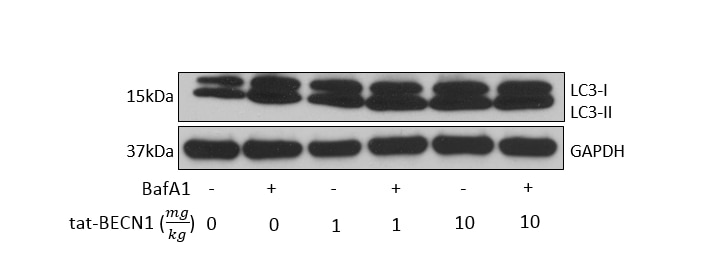
![In vivo assay: Tat-Beclin 1 D11 Autophagy Inducing Peptide - Retroinverso form [NBP2-49888] - In vivo dose study in 10wk old C57BL/6J mice. Either 1mg/kg or 10mg/kg IP once daily was administered for 2 days, mice were sacrificed, kidneys prepared for Western blot analysis. Lysosomal inhibitor bafilomycin A1 was used to provide a measurement of autophagic flux. *vehicle is scrambled tat-beclin (NBP2-49887-5mg). Image from verified customer review.](http://images.novusbio.com/fullsize/Tat-Beclin-1-D11-Autophagy-Inducing-Peptide---Retroinverso-form-In-vivo-assay-NBP2-49888-img0004.jpg "In vivo assay: Tat-Beclin 1 D11 Autophagy Inducing Peptide - Retroinverso form [NBP2-49888] - In vivo dose study in 10wk old C57BL/6J mice. Either 1mg/kg or 10mg/kg IP once daily was administered for 2 days, mice were sacrificed, kidneys prepared for Western blot analysis. Lysosomal inhibitor bafilomycin A1 was used to provide a measurement of autophagic flux. *vehicle is scrambled tat-beclin (NBP2-49887-5mg). Image from verified customer review.")
![In vivo assay: Tat-Beclin 1 L11S Peptide - Scrambled Control [NBP2-49887] - In vivo dose study in mouse kidneys as control for tat-beclin D11 autophagy inducing peptide. Well tolerated by mice at dose of 1mg/kg for 2 days IP. Soluble in PBS. First two lanes (controls) are treated with 1mg/kg tat-beclin scrambled peptide; remaining lanes are treated with tat-beclin D11 autophagy inducing peptide. Image from verified customer review.](https://images.novusbio.com/images/Tat-Beclin-1-L11S-Peptide---Scrambled-Control-In-vivo-assay-NBP2-49887-img0003.jpg "In vivo assay: Tat-Beclin 1 L11S Peptide - Scrambled Control [NBP2-49887] - In vivo dose study in mouse kidneys as control for tat-beclin D11 autophagy inducing peptide. Well tolerated by mice at dose of 1mg/kg for 2 days IP. Soluble in PBS. First two lanes (controls) are treated with 1mg/kg tat-beclin scrambled peptide; remaining lanes are treated with tat-beclin D11 autophagy inducing peptide. Image from verified customer review.")
