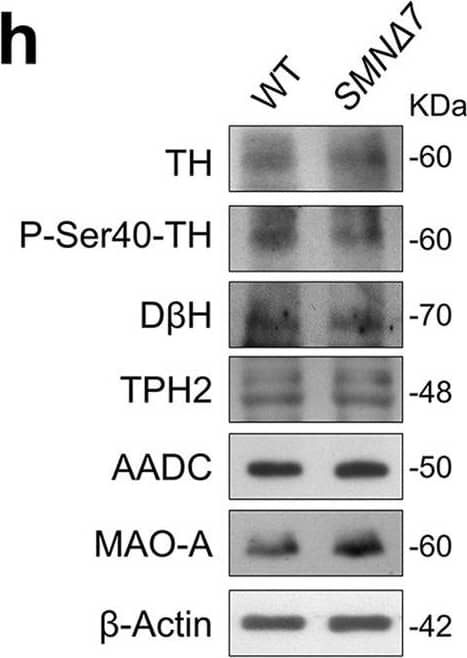
| Immunogen | A synthetic peptide (FGYCNSSLNPVIYTIFNH) corresponding to amino acids 414-431 from human Adrenergic Receptor alpha 2a. To enhance the immunological response, this peptide was coupled to carrier protein BSA. |
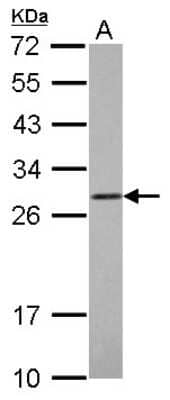
| Specificity | The specificity of this antibody has been confirmed by WB and IHC against the antigen. |
| Clonality | Polyclonal |
| Host | Rabbit |
| Gene | ADRA2A |
| Purity | Immunogen affinity purified |
| Innovator's Reward | Test in a species/application not listed above to receive a full credit towards a future purchase. |
| Dilutions |
|
|
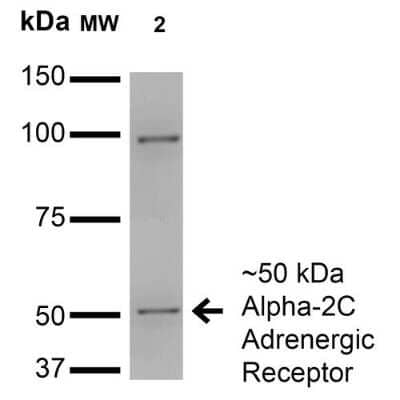
| Application Notes | This antibody is useful in Western Blot Human Adrenergic Receptor alpha 2a has a predicted length of 450 amino acids and MW of 49 kDa. This antibody may also be useful in Immunohistochemistry-paraffin. |
|
| Publications |
|
| Storage | Store at 4C short term. Aliquot and store at -20C long term. Avoid freeze-thaw cycles. |
| Buffer | 0.2 mg DiSodium Phosphate, 0.9 mg NaCl and 5 mg BSA |
| Preservative | 0.05mg Sodium Azide |
| Concentration | LYOPH |
| Purity | Immunogen affinity purified |
| Reconstitution Instructions | Reconstitute with 0.1 ml sterilized distilled water to a final concentration of 1.0 mg/ml. Centrifuge to remove any insoluble material. |




Secondary Antibodies |
Isotype Controls |
Research Areas for alpha-2A Adrenergic R/ADRA2A Antibody (R-1034-100)Find related products by research area.
|
The concentration calculator allows you to quickly calculate the volume, mass or concentration of your vial. Simply enter your mass, volume, or concentration values for your reagent and the calculator will determine the rest.


![Western Blot Androgen R/NR3C4 [p Ser213, p Ser210] Antibody (156C135.2) - BSA Free](https://images.novusbio.com/images/Androgen-R-NR3C4-p-Ser213-p-Ser210-Antibody-156C135-2-Western-Blot-NB100-56603-img0004.jpg)


![Immunocytochemistry Insulin Antibody (182410) [Unconjugated]](https://images.novusbio.com/images2/Insulin_MAB1417_Immunocytochemistry_9376.jpg)
![Immunohistochemistry Insulin Antibody (182410) [Unconjugated]](https://images.novusbio.com/images2/mab1417_human-bovine-mouse-insulin-mab-clone-182410-immunohistochemistry-308202115145.jpg)