We're moving to rndsystems.com. Come with us!

After August 17, 2026, Novus Biologicals products and services will no longer be available on this website; you will access all products and services on rndsystems.com. Create your R&D Systems online account today.

ATM [p Ser1981] Antibody (10H11.E12)

Images


Product Details

Summary
Product Discontinued
View other related ATM Primary Antibodies

Order Details


    • Catalog Number
      NB100-307
    • Availability
      Product Discontinued

    Can't find what you are looking for? Use our Antibody Concierge Service & we will help you locate your antibody!

    Or feel free to contact us for alternative products.

ATM [p Ser1981] Antibody (10H11.E12) Summary

Immunogen
Synthetic peptide made to a region surrounding the phosphorylated Serine 1981 of human ATM. [UniProt# Q13315]
Modification
p Ser1981
Isotype
IgG1 Kappa
Clonality
Monoclonal
Host
Mouse
Gene
ATM
Purity
Unpurified
Innovator's Reward
Test in a species/application not listed above to receive a full credit towards a future purchase.

Applications/Dilutions

Dilutions
  • Immunocytochemistry/ Immunofluorescence 1:500
  • Western Blot 1:1000
Application Notes
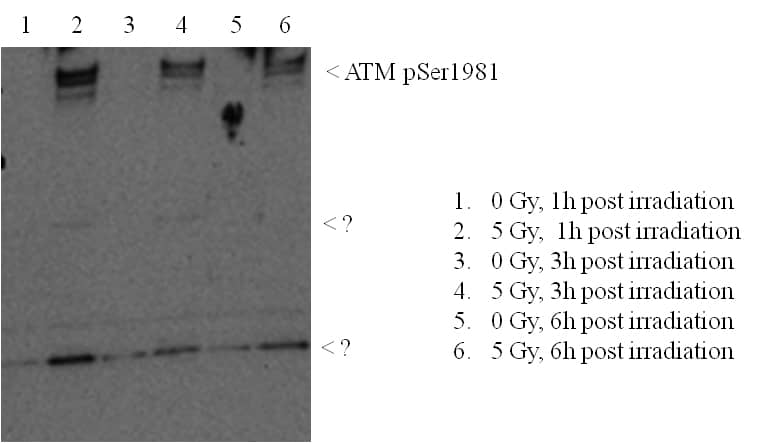
This ATM [p Ser1981] (10H11.E12) antibody is useful for Immunocytochemistry/Immunofluorescence and Western blot, where a single band is seen at ~370 kDa.

The observed molecular weight of the protein may vary from the listed predicted molecular weight due to post translational modifications, post translation cleavages, relative charges, and other experimental factors.
Theoretical MW
370 kDa.
Disclaimer note: The observed molecular weight of the protein may vary from the listed predicted molecular weight due to post translational modifications, post translation cleavages, relative charges, and other experimental factors.
Reviewed Applications
Read 1 Review rated 4
using
NB100-307 in the following applications:

Publications
Read Publications using
NB100-307 in the following applications:

Reactivity Notes

Human, mouse and rat.

Packaging, Storage & Formulations

Storage
Aliquot and store at -20C or -80C. Avoid freeze-thaw cycles.
Buffer
Ascites
Preservative
0.1% Sodium Azide
Purity
Unpurified

Alternate Names for ATM [p Ser1981] Antibody (10H11.E12)

  • AT mutated
  • A-T mutated
  • AT1
  • ATA
  • ataxia telangiectasia mutated (includes complementation groups A, C and D)
  • ataxia telangiectasia mutated
  • ATC
  • ATD
  • ATDC
  • ATE
  • ATM serine/threonine kinase
  • ATM
  • DKFZp781A0353
  • EC 2.7.11.1
  • MGC74674
  • serine-protein kinase ATM
  • TEL1
  • TEL1, telomere maintenance 1, homolog
  • TELO1
  • TPLL

Background

ATM (ataxia telangiectasia mutated kinase) is the master regulator of the DNA double-strand break (DSB) repair pathway. This ubiquitously expressed serine/threonine protein kinase belongs to the PI3K-like family of proteins and responds to DSBs caused by oxidative and other genotoxic stresses (1). In addition to regulating the DNA damage response, ATM participates in vesicle and protein transport, T-cell development, gonads/neurological function, pre-B cell allelic exclusion, cell cycle control, and acts as a tumor suppressor (2,3). Defects in ATM are associated with ataxia telangiectasia (AT), T-cell acute lymphoblastic leukemia (TALL), T-prolymphocytic leukemia (TPLL), and B-cell non-Hodgkin lymphomas (BNHL) including mantle cell lymphoma (MCL) and B-cell chronic lymphocytic leukemia (BCLL) (4).

The theoretical molecular weight of ATM is 350 kDa and it has 3 main domains: a FAT (focal adhesion targeting) domain (aa 1960-2566), a PI-3/PI-4 kinase catalytic domain (aa 2712-2962), and a C-terminal FAT domain (aa 3024-3056). ATM exists as a dimer or tetramer in its inactive state. Upon sensing DNA damage, the MRE11-RAD50-NBS1 (MRN) complex recruits ATM. The intricate process of ATM activation involves acetylation by KAT5/TIP60, autophosphorylation at Ser-1981, and dissociation into catalytically active monomers (5). Following activation, ATM phosphorylates multiple substrates such as p53/TP53 and Chk2 involved in DNA repair, checkpoint signaling, and the apoptosis pathway.

References

1. Paull TT. (2015) Mechanisms of ATM Activation. Annu Rev Biochem. 84:711-38. PMID: 25580527

2. Chaudhary MW and Al-Baradie RS. (2014) Ataxia-telangiectasia: future prospects. Appl Clin Genet. 7:159-167. PMID: 25258552

3. Stagni V, Cirotti C, and Barila D. (2018) Ataxia-Telangiectasia Mutated Kinase in the Control of Oxidative Stress, Mitochondria, and Autophagy in Cancer: A Maestro With a Large Orchestra. Front Oncol. 8:73. PMID: 29616191

4. Gumy-Pause F, Wacker P, and Sappino AP. (2004) ATM gene and lymphoid malignancies. Leukemia. 18(2):238-42. PMID: 14628072

5. Adamowicz M. (2018) Breaking up with ATM. J Immunol Sci. 2(1):26-31. PMID: 29652413

Limitations

This product is for research use only and is not approved for use in humans or in clinical diagnosis. Primary Antibodies are guaranteed for 1 year from date of receipt.

Customers Who Viewed This Item Also Viewed...

NBP1-30027
Species: Hu, Mu, Rt
Applications: ICC/IF, IHC,  IHC-P, WB
NB200-103
Species: Hu, Mu, Rt, Xp(-), Ye
Applications: CyTOF-ready, ELISA, Flow-IC, Flow, ICC/IF, IHC, IHC-Fr,  IHC-P, IP, WB
NB100-308
Species: Hu, Mu
Applications: Func, ICC/IF, IP, In vitro, KO, WB
NBP2-03417
Species: Hu, Mu, Rt
Applications: Flow, IHC,  IHC-P, WB
NB100-56585
Species: Hu
Applications: ICC/IF, IHC,  IHC-P, WB
NBP2-71688
Species: Ca, Hu, Mu, Rt
Applications: CyTOF-ready, Flow, ICC/IF, IHC,  IHC-P, IP, WB
DAN00
Species: Hu
Applications: ELISA
NB100-464
Species: Hu, Mu
Applications: IHC,  IHC-P, IP, WB
NB100-143
Species: Ha, Hu, Ma, Mu, Pm
Applications: ChIP, ChIP, ELISA, Flow, IB, ICC/IF, IHC,  IHC-P, IP, ISH, KD, KO, PAGE, WB
NBP1-77368
Species: Hu, Mu, Rb, Rt
Applications: ELISA, ICC/IF, IHC,  IHC-P, WB
AF1513
Species: Mu
Applications: CyTOF-ready, Flow, IHC, IP, Simple Western, WB
NBP2-29463
Species: Pm, Hu, Pm, Mu
Applications: Flow, ICC/IF, IHC,  IHC-P, WB
NB100-658
Species: Hu
Applications: IP, KD, WB
NB100-404
Species: Hu
Applications: ChIP, ICC/IF, IHC,  IHC-P, IP, KD, KO, WB
NB100-56155
Species: Hu
Applications: IHC,  IHC-P, IP, WB
NB100-304
Species: Bt, Bv, Ca, Fi, Gt, Hu, Mu, Pm, Rt
Applications: ChIP, ChIP, COMET, Flow-IC, Flow, IB, ICC/IF, IHC, IHC-Fr,  IHC-P, IP, ISH, KD, KO, mIF, Simple Western, WB
DY417
Species: Mu
Applications: ELISA
AF4277
Species: Mu
Applications: ELISA(Cap), ELISA(Det), ELISA(Sta), IHC, IP, WB

Publications for ATM Antibody (NB100-307)(5)

Review for ATM Antibody (NB100-307) (1) 41

Average Rating: 4
(Based on 1 review)
We have 1 review tested in 1 species: Human.

Reviews using NB100-307:
Filter by Applications
WB
(1)
All Applications
Filter by Species
Human
(1)
All Species
Images Ratings Applications Species Date Details
Western Blot ATM NB100-307
Enlarge
4
reviewed by:
Verified Customer
WB Human 03/14/2014
View

Summary

ApplicationWestern Blot
Sample TestedUVW glioma cell line whole cell lysate
SpeciesHuman
LotA3

Product General Protocols

View specific protocols for ATM Antibody (NB100-307): Find general support by application which include: protocols, troubleshooting, illustrated assays, videos and webinars.

Video Protocols

WB Video Protocol
ICC/IF Video Protocol

FAQs for ATM Antibody (NB100-307). (Showing 1 - 2 of 2 FAQs).

  1. What is the theoretical molecular weight for your ATM antibodies?
    • The theoretical molecular weight for our ATM antibodies is 351 kDa.
  2. Is it possible to let me know what is the difference between NB100-307 and NB100-306 which are the same clone?
    • NB100-307 is unpurified mouse ascites, while NB100-306 is the purified version of the same antibody. They should detect similarly, with the purified one providing less background, and is tested in more applications.

Secondary Antibodies


Isotype Controls

Additional ATM Products

Research Areas for ATM Antibody (NB100-307)

Find related products by research area.

Blogs on ATM.

Further unraveling the role of gamma H2AX in DNA damage response
Our genome experiences a moderate amount of DNA damage in our cells on a daily basis.  This DNA damage can be in response to external environmental factors, or be a result of our internal metabolic processes going awry.  While normal rates of DNA ...  Read full blog post.

The recent relationship of BRCA1 and 53BP1
The p53-binding protein 1 (53BP1) is a DNA damage response factor, which is recruited to nuclear structures at the site of DNA damage.  DNA double-strand breaks (DSBs) are mutations that are detrimental to cell viability and genome stability, and m...  Read full blog post.

Application Highlight: Recent uses of TERF2 in immunofluorescence (IF)
Telomeres are a region of repeat nucleotide sequences located at the end of chromosomes to protect our DNA from becoming damaged via end-to-end fusion.  TERF2, or telomeric-repeat binding factor 2, is important for telomere integrity and aids in th...  Read full blog post.

ATM - detecting and responding to DNA damage
Ataxia telangiectasia mutated (ATM) is essential for the maintenance of genomic stability. ATM is a 370 kDa serine-threonine kinase that is constitutively expressed in various tissues. Although primarily nuclear, ATM is also found at lower levels ...  Read full blog post.

53BP1 - a marker for DNA Double Strand Break
53BP1 (p53 binding protein 1) was originally thought to be an enhancer for p53 transcriptional, but later studies have demonstrated that it is actually a substrate for ataxia telangiectasia mutated (ATM). 53BP1 is a classic late DNA damage response...  Read full blog post.

53BP1 - DNA damage is no fun
The 53BP1 (p53 binding protein 1) was initially believed to be a p53 transcriptional enhancing partner, but it has now been established as an ataxia telangiectasia mutated (ATM) substrate. As a late DNA damage response (DDR) marker, 53BP1 appears duri...  Read full blog post.

ATM and DSB Repair in Cancer
Ataxia Telangiectasia Mutated (ATM) is a serine/threonine protein kinase that is the master regulator of the DNA double-strand break (DSB) repair pathway. ATM is a key part of the cell cycle machinery that activates checkpoint signaling in response to...  Read full blog post.

Contact Information

Product PDFs

Calculators

Concentration Calculator

The concentration calculator allows you to quickly calculate the volume, mass or concentration of your vial. Simply enter your mass, volume, or concentration values for your reagent and the calculator will determine the rest.

=
÷

Recent Reviews

4
5
0
4
1
3
0
2
0
1
0

Verified Customer
03/14/2014
Application: WB
Species: Human

Bioinformatics

Gene Symbol ATM
Entrez
Uniprot