| Specificity | breast cancer 1, early onset (BRCA1), transcript variant BRCA1-delta9-11, mRNA |
| Gene | BRCA1 |
| Dilutions |
|
| Application Notes | This RNAi causes protein knockdown. |
| Storage | Store at -20C. Avoid freeze-thaw cycles. |
| Buffer | DEPC-treated Water |


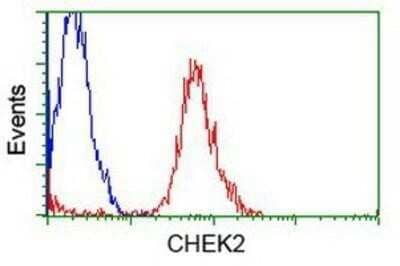
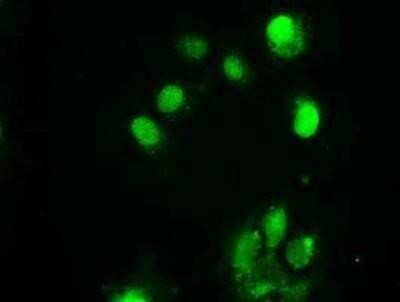


![Immunohistochemistry EGFR Antibody [Unconjugated]](https://images.novusbio.com/images2/EGF_R_AF231_Immunohistochemistry_20892.jpg)
![Immunocytochemistry EGFR Antibody [Unconjugated]](https://images.novusbio.com/images2/EGF_R_AF231_Immunocytochemistry__Immunofluorescence_21143.jpg)
![Western Blot EGFR Antibody [Unconjugated]](https://images.novusbio.com/images2/EGF_R_AF231_Western_Blot_19925.jpg)


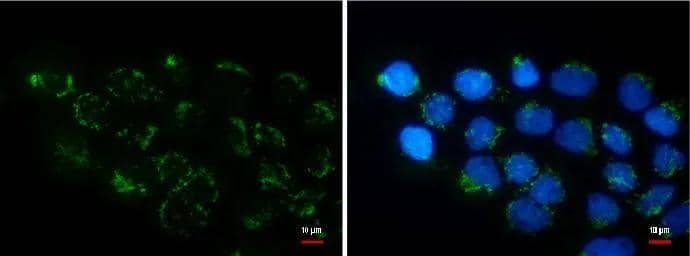
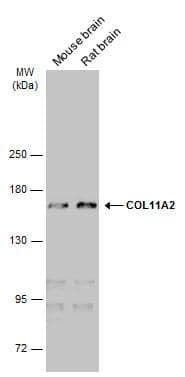



Research Areas for BRCA1 RNAi (H00000672-R05)Find related products by research area.
|
|
NPC1: A Potential Target For Triple-Negative Breast Cancer By Natalia Gurule, PhD Breast Cancer is a Heterogeneous DiseaseBreast cancer is the most frequently identified malignancy in women, accounting for 30% of diagnosed cases of cancer in women in the US annuall... Read full blog post. |
|
Autophagy: Pro or Anti-tumorigenic? And the role of epigenetics in this debate By Christina Towers, PhDAutophagy is an evolutionarily conserved process that cells use to break down damaged cytoplasmic constituents in order to fuel cellular metabolism, particularly in instances of stress. This process has been heavily ... Read full blog post. |
|
Further unraveling the role of gamma H2AX in DNA damage response Our genome experiences a moderate amount of DNA damage in our cells on a daily basis. This DNA damage can be in response to external environmental factors, or be a result of our internal metabolic processes going awry. While normal rates of DNA ... Read full blog post. |
|
The recent relationship of BRCA1 and 53BP1 The p53-binding protein 1 (53BP1) is a DNA damage response factor, which is recruited to nuclear structures at the site of DNA damage. DNA double-strand breaks (DSBs) are mutations that are detrimental to cell viability and genome stability, and m... Read full blog post. |
|
ATM - detecting and responding to DNA damage Ataxia telangiectasia mutated (ATM) is essential for the maintenance of genomic stability. ATM is a 370 kDa serine-threonine kinase that is constitutively expressed in various tissues. Although primarily nuclear, ATM is also found at lower levels ... Read full blog post. |
|
FANCD2 (Fanconi anemia subunit D2 protein) Fanconi anemia (FANC) is a rare, autosomal-recessive genetic disorder that is a heterogeneous cancer susceptibility condition that manifests with a wide range of symptoms such as congenital malformations, deteriorating bone marrow failure, DNA-dama... Read full blog post. |
|
53BP1 - a marker for DNA Double Strand Break 53BP1 (p53 binding protein 1) was originally thought to be an enhancer for p53 transcriptional, but later studies have demonstrated that it is actually a substrate for ataxia telangiectasia mutated (ATM). 53BP1 is a classic late DNA damage response... Read full blog post. |
|
FANCD2: A big component of the DNA repair crew The genetic disorder known as Fanconi anemia (FANC) is a heterogeneous, autosomal-recessive cancer susceptibility condition characterized by a wide array of symptoms. These include congenital malformations, progressive bone marrow failure, DNA-damage ... Read full blog post. |
|
BRCA1 - A Critical Tumor Suppressor Gene in Women Breast cancer 1, early onset (BRCA1) is a well-known tumor suppressor gene that was originally discovered due to its link with early-onset breast and ovarian cancer in women. The BRCA1 protein contains the following domains: RING finger, RAD51-interac... Read full blog post. |
|
53BP1 - DNA damage is no fun The 53BP1 (p53 binding protein 1) was initially believed to be a p53 transcriptional enhancing partner, but it has now been established as an ataxia telangiectasia mutated (ATM) substrate. As a late DNA damage response (DDR) marker, 53BP1 appears duri... Read full blog post. |


![Western Blot BRCA2 Antibody (234403) [Unconjugated]](https://images.novusbio.com/images2/BRCA2_MAB2476_Western_Blot_6033.jpg)
![Immunohistochemistry BRCA2 Antibody (234403) [Unconjugated]](https://images.novusbio.com/images2/mab2476_human-brca2-mab-clone-234403-immunohistochemistry-10520211657.jpg)
![Western Blot BRCA2 Antibody (234403) [Unconjugated]](https://images.novusbio.com/images/mab2476_human-brca2-mab-clone-234403-2282024172111.jpg)
![SDS-PAGE ErbB2/Her2 [Unconjugated]](https://images.novusbio.com/images2/ErbB2_1129-ER_70.jpg)
![Bioactivity ErbB2/Her2 [Unconjugated]](https://images.novusbio.com/images2/1129-er_recombinant-human-erbb2-her2-fc-chimera-protein-cf-bioactivity-7122020142841.jpg)
![Immunocytochemistry Progesterone R/NR3C3 Antibody [Unconjugated]](https://images.novusbio.com/images2/Progesterone_R_AF5415_Immunocytochemistry__Immunofluorescence_20674.jpg)
![Immunohistochemistry Progesterone R/NR3C3 Antibody [Unconjugated]](https://images.novusbio.com/images2/Progesterone_R_AF5415_Immunohistochemistry_20779.jpg)
![Western Blot Progesterone R/NR3C3 Antibody [Unconjugated]](https://images.novusbio.com/images2/Progesterone_R_AF5415_Western_Blot_5715.jpg)